Ninth Fort Kaunas — Holocaust memorial and museum guide
Kaunas: Ninth fort dark history tour
What is the Ninth Fort in Kaunas?
The Ninth Fort (IX fortas) is a 19th-century Russian Imperial fortification on the edge of Kaunas that became one of the major killing sites of the Holocaust in Lithuania, where approximately 50,000 people — primarily Jews from Kaunas and across Europe — were shot in 1941–1944. It is now a memorial museum.
The Russian Imperial Army built a ring of defensive forts around Kaunas in the late 19th century, numbered one through nine. The Ninth Fort, on the city’s northwestern edge, was the last built (1902–1909) and the least used for its original military purpose. In 1941, it was given a different function — one that has made its name recognisable to historians of the Holocaust across the world.
Between July 1941 and the autumn of 1944, approximately 50,000 people were shot at the Ninth Fort. The victims were predominantly Jews — from Kaunas, from surrounding Lithuanian towns, and from Germany, Austria, France, and Czechoslovakia. The Ninth Fort was a killing site, and it is now a memorial and museum that addresses what happened there with the seriousness the subject demands.
| Where | Žemaičių plentas 73, 6 km from central Kaunas |
| Cost | around €5 adults, €2.50 students |
| Time needed | 1.5–2.5 hours |
| Getting there | Bus 35/23 from Kaunas centre, or a day trip from Vilnius |
| Combine with | Kaunas Old Town, same day |
Historical context: the Jews of Kaunas
Kaunas (called Kovno in Yiddish and Polish) had a Jewish community of approximately 37,000–40,000 people on the eve of the German invasion in June 1941, accounting for about 25% of the city’s population. Unlike the Polish–Lithuanian communities of Vilna with their deep medieval roots, Kaunas Jewry had a different political character: the community was home to significant Zionist movements, a Hebrew-language gymnasium, and intellectuals who engaged intensely with the questions of Jewish national identity that dominated early 20th-century Jewish life.
Kaunas was the temporary capital of independent Lithuania (1920–1940), while Vilna was under Polish control. The Jewish community thrived during this period — operating schools, hospitals, cultural organisations, and political parties with relative freedom under Lithuanian law.
The Soviet occupation of June 1940 struck the community hard — Soviet law prohibited Zionist organisations and Hebrew education, and the NKVD deported several hundred Jewish community leaders in the June 1941 deportations. However, the catastrophe of the German occupation, beginning on June 24, 1941, was of an entirely different order of magnitude.
The Kaunas Massacre of 1941
The German Army entered Kaunas on June 24, 1941. Within days, violent pogroms began — initially organised by Lithuanian nationalist elements but quickly subsumed into the German operational system.
The most documented early episode is the Kaunas Garage Massacre (Lietūkis garage, June 27, 1941), in which approximately 40–60 Jewish men were beaten to death by Lithuanian nationalists while crowds watched. German soldiers photographed the event; the images were later used as evidence at Nuremberg.
The systematic killing was organized through the Kaunas Ghetto, established in the Vilijampolė district (Slobodka) in August 1941, and through a series of “Aktions” — coordinated mass arrests and killings at the Ninth Fort.
The Ninth Fort killings operated under the command of SS-Standartenführer Karl Jäger, head of Einsatzkommando 3, whose detailed reports survive and are among the most important documentary records of the Holocaust in the Baltic states. Jäger’s “Jäger Report” (December 1, 1941) lists killing operations day by day, location by location, with numbers and victim categories recorded with bureaucratic precision. It lists the executions at the Ninth Fort among others.
Major killing dates at the Ninth Fort include:
- August–September 1941: approximately 10,000 Kaunas Jews killed in a series of Aktions
- October 28–29, 1941 (the “Great Action”): approximately 9,200 people killed in a single two-day operation — men, women, and children selected from the ghetto population
- November–December 1941: Jews deported from Germany, Austria, and France — approximately 5,000 people — were taken from Kaunas railway station directly to the Ninth Fort and killed
The deportees from Western Europe constitute a distinctive element of the Ninth Fort’s history. These were Jews from Frankfurt, Munich, Vienna, Paris, and other cities who were loaded onto trains under the pretence of “resettlement in the East” and arrived at Kaunas with their luggage, expecting to find accommodation and work. They were killed within hours of arrival.
Evidence destruction and the burning brigade
As at Paneriai near Vilnius, the Germans attempted to destroy evidence of the killings in 1943–1944. Jewish prisoners (the “burning brigade”) were forced to exhume and burn the bodies in the fort’s pits.
On December 25–26, 1943, a group of prisoners escaped from the Ninth Fort — 64 people, breaking through a wall and into the surrounding countryside. Unlike the Paneriai escape (April 1944, where 12 of 40 survived), the majority of the Ninth Fort escapees survived. Their testimonies at post-war trials provided crucial documentation of what had occurred.
The memorial and museum
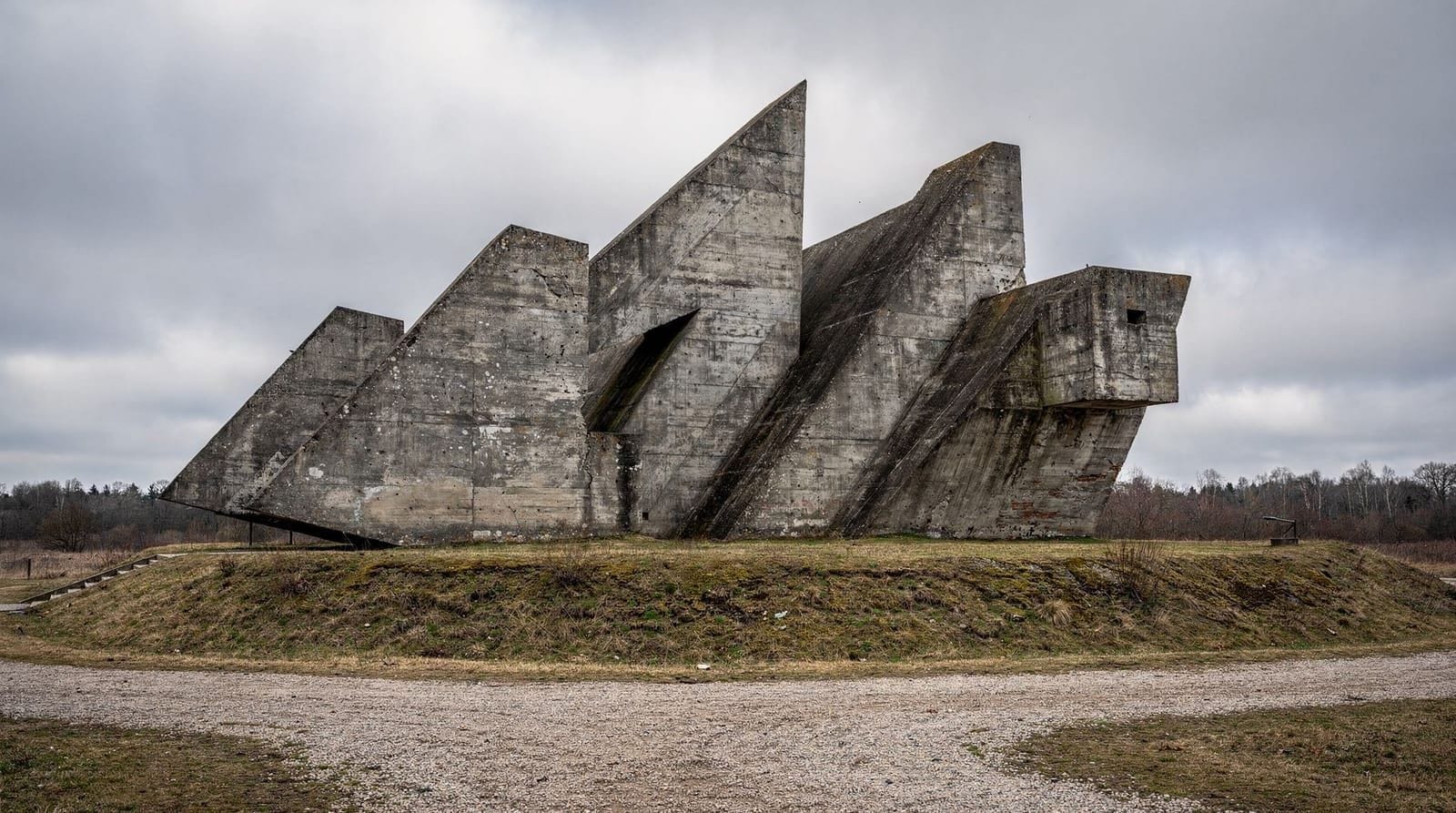
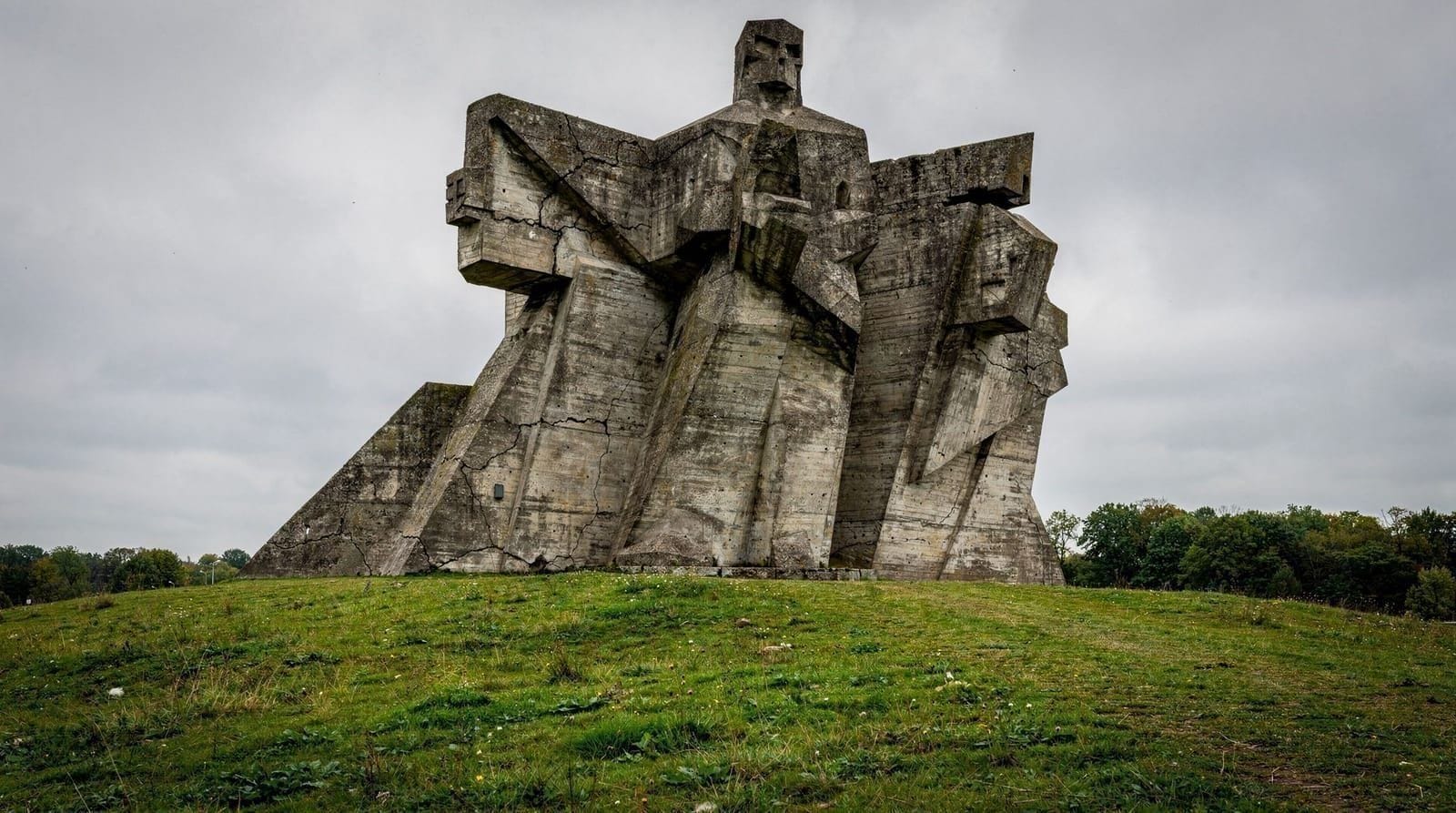
The monument: The vast concrete monument at the Ninth Fort entrance (sculptor Gediminas Jokūbonis, completed 1984) is one of the most powerful pieces of public art in Lithuania. Three 32-metre abstract human figures, in granite-grey concrete, lean against each other — simultaneously supporting and collapsing. It is harsh, uncompromising architecture that makes no attempt at consolation. The scale and the texture of the material (poured concrete on a rough wooden formwork) are deliberately anti-monumental in the conventional sense.
The museum: The museum occupies part of the fort’s original interior structures. The exhibition covers the history of the fort (from 19th-century fortification through WWI use and the interwar period as a prison), the pre-war Kaunas Jewish community, the 1941 massacres, the broader Holocaust in Lithuania, and the post-war documentation and trials.
Key exhibits include:
- The Jäger Report — reproduced in full with translation
- Photographs from the 1941 Aktions (some taken by German soldiers, recovered after the war)
- Personal objects recovered from the execution pits during archaeological work
- Survivor testimonies (audio, in English)
- The story of the December 1943 escape
The museum’s English-language materials are comprehensive. An audio guide is available.
The execution pits: The areas where killing took place are accessible on the memorial grounds. Like Paneriai, these are depressions in the ground — the pits were partially filled after the evidence-burning operations. They are marked with memorial stones and bordered by pathways.
A guided Ninth Fort dark history tour from Kaunas provides the contextual framework that makes the visit comprehensible — particularly the Jäger Report documentation, the survivor escape accounts, and the connection to the broader European geography of the Final Solution.
How the Ninth Fort compares to Vilnius’s Holocaust and occupation sites
Visitors researching Lithuania’s 20th-century history often try to decide between the Ninth Fort and the equivalent sites near Vilnius. They’re not substitutes for each other — each documents a distinct history.
Paneriai, 10 km from Vilnius, is the closest parallel: another forest execution site with a similarly small, carefully curated museum and marked pits. The Ninth Fort’s museum is larger and more extensively documented, partly because the fort itself (with intact fortification structures) offers more physical space for exhibition than Paneriai’s more modest facilities.
The KGB Museum in Vilnius covers a different history — Soviet-era political repression rather than the Holocaust specifically — though the two eras overlap in the wider story of 20th-century Lithuanian suffering covered in the Soviet history of Vilnius guide. For a fuller picture of pre-war Jewish life in Lithuania before visiting either site, the Jewish Vilnius and Vilna Gaon guide provides useful context, even though it focuses on Vilnius rather than Kaunas specifically.
If you’re planning a Lithuania trip focused on this history, visiting more than one of these sites deepens understanding considerably — each adds a different layer to the same broader story.
Combining with Kaunas
The Ninth Fort is 6 km from central Kaunas, making it practical to combine with a visit to Kaunas Old Town and the Kaunas city centre on the same day.
Kaunas Old Town has its own substantial historical and architectural heritage — interwar modernist architecture (designated UNESCO World Heritage Site in 2023), the Kaunas Cathedral (oldest Gothic church in Lithuania), and the iconic Kaunas Castle. The Old Town is walkable in 2–3 hours.
Combined day itinerary: Start at the Ninth Fort (morning, 2 hours). Bolt to Kaunas city centre (15 minutes). Walk the Old Town (1–1.5 hours). Lunch at Bernelių Užeiga (Valančiaus gatvė 9, Lithuanian food, €10–16 main). Afternoon at Kaunas museums or the park along the Nemunas-Neris confluence.
A Kaunas city walking tour provides a good introduction to the city’s history and architecture — useful before or after the Ninth Fort visit for context on the broader Kaunas story.
Day trip from Vilnius
The Ninth Fort can be reached from Vilnius in a day. By train or bus from Vilnius to Kaunas (1 hour, roughly every 30 minutes, €4–8). From Kaunas bus station, Bus 35 northbound or a Bolt to the fort. See the Kaunas day trip guide for the fuller logistics of combining the Ninth Fort with the rest of the city in one day from Vilnius.
Alternatively, a guided day trip from Vilnius handles transport and provides the narrative framework for both sites.
A full-day Kaunas tour from Vilnius covers Kaunas’s main sights and can be a useful base if you want to combine the Ninth Fort with the city’s other highlights in one organised day. For the wider menu of day-trip options from the capital, see the best day trips from Vilnius guide.
Practical information
Address: Žemaičių plentas 73, Kaunas 47362 | 9fortomuziejus.lt
Opening hours: May–October Tuesday–Sunday 9 am–7 pm; November–April Wednesday–Sunday 9 am–5 pm; closed Monday
Entry: Adults €5 / Students €2.50 / Under 7 free. Audio guide €2. Guided tours available by arrangement (advance booking recommended).
Getting there: Bus 35 or 23 from Kaunas city centre (Laisvės al. stop), direction Žemoji Fredos or Akademija, alight at “IX fortas” stop. Or Bolt from Kaunas centre (€6–9).
Time needed: 1.5–2.5 hours for the museum and memorial grounds
Accessibility: The museum building is wheelchair accessible. The external memorial grounds have some uneven paths.
Nearest food: No café on site. Petrol stations and a basic supermarket are on Žemaičių plentas 800 m away. Eat before visiting or return to Kaunas centre.
Frequently asked questions about the Ninth Fort
Were any Kaunas Jews saved?
Approximately 2,000–3,000 Jews from the Kaunas ghetto survived the war — some through hidden rescue by Lithuanian families, some by escaping to the forests and joining Soviet or Jewish partisan groups, some through luck in the final chaos of the German retreat in 1944. The Yad Vashem database of “Righteous Among the Nations” lists Lithuanian rescuers, including several from Kaunas.
Who was responsible for the Ninth Fort killings?
Primary responsibility lay with the German command — Einsatzkommando 3 under Karl Jäger, and the broader SS hierarchy. Jäger was arrested after the war but died in prison in 1959 before trial. The 2nd Lithuanian Auxiliary Police Battalion participated directly in many of the killings — this is documented in post-war trials and historical research. The question of broader Lithuanian collaboration was contested politically for decades after independence but is now part of the official historical record.
Is there a memorial book for the Ninth Fort victims?
The Yad Vashem Names Database includes many Kaunas victims. The museum maintains research files and can assist with family history research. The Central Database of Shoah Victims’ Names is at yadvashem.org/names.
Can I photograph at the Ninth Fort?
Photography of the memorial, the monument, the museum exhibits, and the grounds is permitted. Respectful documentary photography is appropriate. The same principles apply as at Paneriai — witness rather than performance.
Should I visit the Ninth Fort and Paneriai, or is one enough?
If your trip includes both Vilnius and Kaunas, visiting both is worthwhile — they document related but distinct chapters of the same history, and the Ninth Fort’s larger museum adds context (the Jäger Report, the Western European deportations) that Paneriai’s smaller exhibition doesn’t cover in the same depth. If you can only fit one, choose based on which city you’re spending more time in; both are equally serious, well-curated memorials.
Is the Ninth Fort appropriate for teenagers?
Yes, for most teenagers with some prior context — the museum’s documentary approach (photographs, documents, testimony) is factual rather than graphic, similar in tone to the Ninth Fort’s Vilnius counterparts. Preparing teenagers beforehand with some background on the Holocaust in Lithuania, perhaps via the Jewish Vilnius guide, makes the visit more meaningful than arriving without context.
Top experiences
Bookable activities with verified prices and instant confirmation on GetYourGuide.