Jewish Vilnius and the Vilna Gaon — a heritage guide
Vilnius: Jewish heritage 3 hour tour
Duration: 3 hours
What was Jewish Vilna and what remains to see today?
Vilna (the Yiddish and Hebrew name for Vilnius) was one of the world's leading centres of Jewish scholarship for three centuries, home to the Vilna Gaon and a community of over 100,000 people before the Holocaust. The Great Synagogue was destroyed. What remains includes the Choral Synagogue, several heritage sites, two museums, and the ongoing archaeological excavation of the Great Synagogue's foundations.
For three centuries, from the early 1600s until 1941, Vilnius was one of the most important cities in Jewish intellectual and cultural life. Its Yiddish name — Vilna — resonated across the Ashkenazi world as a byword for scholarship, debate, and learning. The city was home to printing presses that produced seminal Talmudic texts, to scholars whose influence still shapes Jewish thought, and to a community whose vibrancy was evident in dozens of synagogues, community organisations, schools, newspapers, and theatres operating simultaneously at their peak.
That community was destroyed in 1941 with a speed and totality that is still difficult to comprehend. Understanding what was lost — and what traces remain — is one of the most important things a visitor to Vilnius can do.
| Where | Former Jewish quarter, Old Town; Vilna Gaon Museum sites |
| Cost | around €5–8 museum entry; free at the Choral Synagogue |
| Time needed | half a day minimum; a full day for the complete itinerary |
| Getting there | On foot within the Old Town; Paneriai by suburban train |
| Best paired with | Vilnius Old Town guide |
The Jerusalem of Lithuania
Vilna earned the epithet “Jerusalem of Lithuania” (Yerushalayim d’Lita in Yiddish) from Jewish scholars themselves, acknowledging the city as a centre of Torah study and rabbinic authority that was the equal of any Jewish community in Europe. The community’s origins go back to the 15th century, though Jews were formally expelled from Vilnius in 1527 by the Grand Duchy’s authorities (a common pattern in European cities of the period). Jews resettled in the city’s surroundings and gradually returned; by the 17th century, a substantial community had re-established itself.
The Great Synagogue of Vilna (Gaon Synagogue), built in the early 17th century on Žydų gatvė, became the symbolic centre of this community. Contemporary accounts describe it as one of the architectural marvels of the region — a Renaissance and Baroque building with a large main prayer hall, multiple inner courts, and a courtyard that functioned as the community’s public square. It survived fires, wars, and occupations for over 300 years.
The printing presses of Vilna played a critical role in the standardisation of Jewish texts. The publishing house of Romm, established in 1789 and operating until 1939, produced the Vilna Talmud — the edition of the Babylonian Talmud that became the global standard reference text, with its distinctive page layout still used in virtually every Talmud printed today.
The Vilna Gaon
Rabbi Elijah ben Solomon Zalman (1720–1797) is the central figure of Jewish Vilna and one of the most remarkable scholars in the history of Jewish learning. Known universally as the Gaon — meaning genius or excellence — of Vilna, he was born in Selts (Sielec), raised partly in Vilnius, and lived there from his early twenties until his death.
The Gaon never held a formal rabbinical position. He was supported by the community as a private scholar, studying for 18–20 hours daily (he reportedly limited sleep to two hours). His output was extraordinary: commentaries on virtually the entire Hebrew Bible, the Talmud, the Zohar (Kabbalistic texts), the Shulchan Aruch (the standard code of Jewish law), mathematical and astronomical treatises, and works on Hebrew grammar and vocabulary. He also had an unusual enthusiasm for secular sciences — mathematics, natural philosophy, and medicine — which he considered necessary for the proper interpretation of religious texts.
The Gaon’s influence on Jewish thought operated through his students rather than published works (much of his writing was published posthumously). His school of Talmudic analysis — precise, logical, textually rigorous, suspicious of casuistry — became the model for Lithuanian Jewish scholarship and through it influenced the great Yeshiva network of Eastern Europe and eventually America and Israel.
He is also known for his opposition to the emerging Hasidic movement in the late 18th century, issuing bans of excommunication (cherem) against the Hasidim in Vilna on multiple occasions. This conflict — between the Gaon’s rationalist Talmudism and the experiential, charismatic spirituality of Hasidism — was one of the defining controversies of 18th-century Jewish life.
The Gaon died on September 23, 1797. His grave in the Jewish cemetery in Šnipiškės was preserved through all subsequent periods, including the Holocaust, and remains a place of pilgrimage for Jews from around the world.
Visiting the Gaon’s grave: The Jewish cemetery at Ozo gatvė 16 (Šnipiškės, north of the Neris river) holds the Gaon’s ohel (memorial structure over the grave) and is accessible to visitors. Open daily sunrise to sunset; closed on Jewish holidays. Bus or taxi from the Old Town, approximately 15 minutes.
What remains: the heritage sites
Choral Synagogue (Chorální sinagoga)
Pylimo gatvė 39 · Open to visitors Monday–Friday 9 am–2 pm (services daily morning and evening)
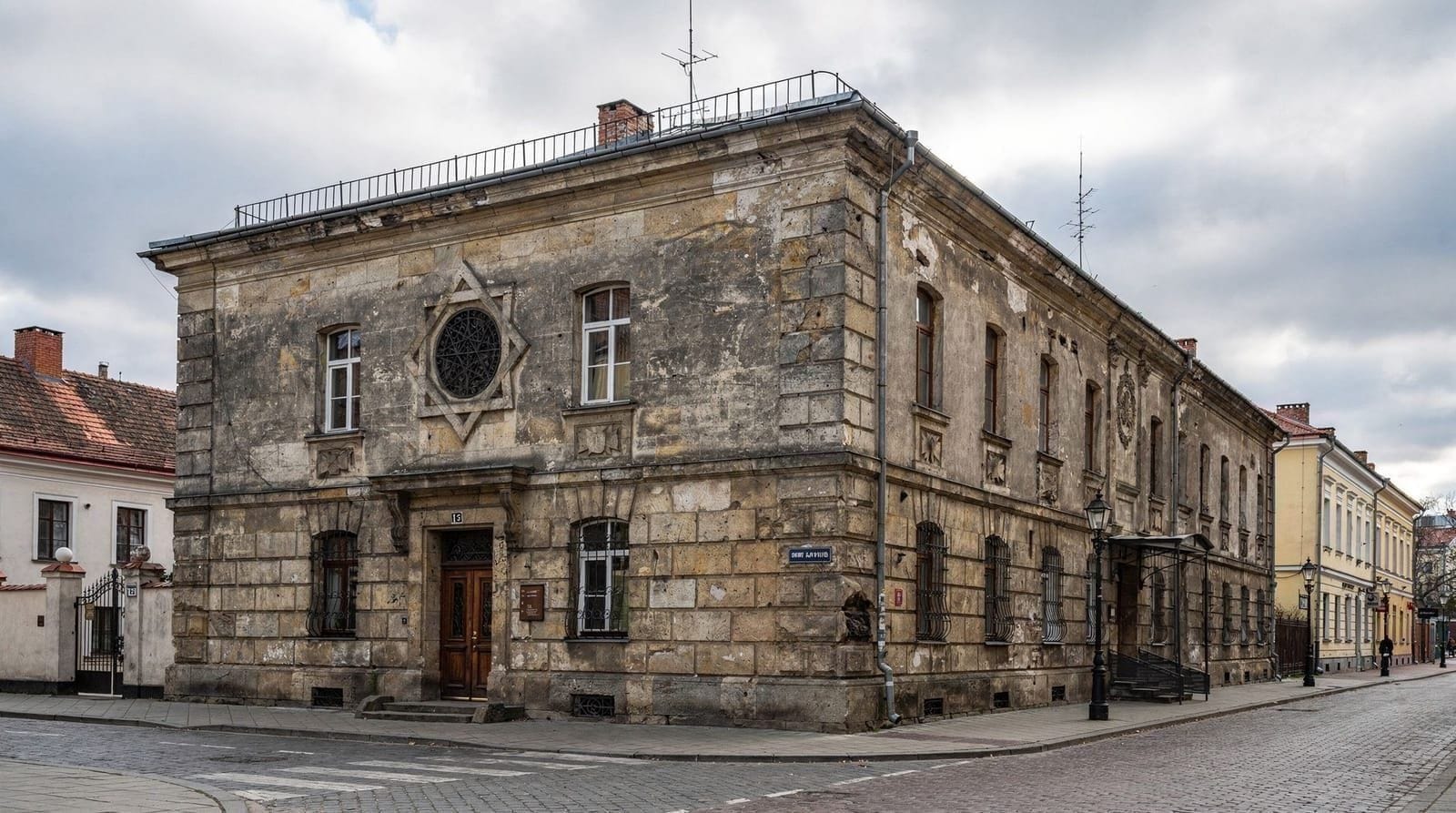
The only pre-WWII synagogue building still functioning as a synagogue in Vilnius. Built in 1903 in Moorish-Neo-Romanesque style, it survived the German occupation because it was used as a storage facility. The interior retains its pre-war character: a large main hall with gallery, original wooden ark, and stained glass. Modest dress required; men wear kippah (available at entrance).
Entry to services is free; organised visits during opening hours can be arranged through the Jewish Community of Lithuania (jkl.lt).
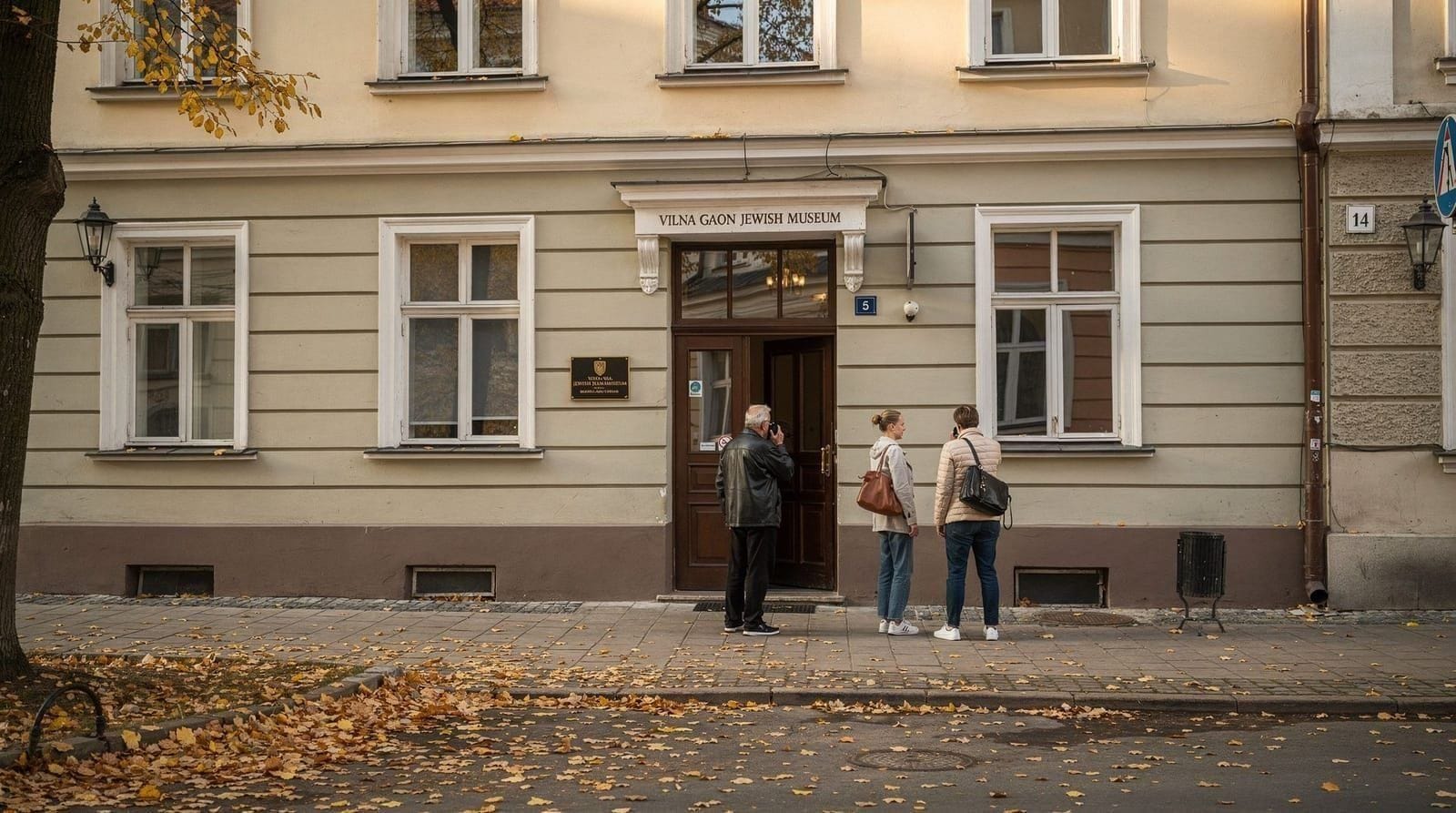
Vilna Gaon State Jewish Museum (two locations)
Main building: Pylimo gatvė 4 | Open Monday–Thursday 9 am–5 pm, Friday 9 am–4 pm, Sunday 10 am–4 pm | Entry €5
Green House (Holocaust exhibition): Pamėnkalnio gatvė 12 | Same hours | Entry €5 (or combined €8)
The Vilna Gaon Museum has two distinct sites. The main building covers the history of Jewish Vilna through the pre-war period — community life, religious and cultural organisations, the printing tradition, the Gaon himself. The documentation is thorough and the English translations are good.
The Green House contains the Holocaust documentation: photographs, survivor testimonies, statistical evidence, and material objects from the period 1941–1944. This is not an easy exhibition. It is presented with historical rigour rather than emotional manipulation, which makes it more rather than less affecting.
The Great Synagogue archaeological site
Žydų gatvė 3 / Pylimo gatvė 4 (Vilniaus “Šaltinio” progymnasium school courtyard)
The Great Synagogue of Vilna was demolished by the Nazis in 1941–1943 and the remaining structure was levelled by the Soviets in 1955–1957, who built a primary school on the site. Archaeological excavations from 2015 (University of Vilnius with international partners) exposed significant foundations, architectural elements, decorative stonework, and personal objects (synagogue furniture fragments, menorahs, prayer shawl fragments, coins).
The excavation area in the school courtyard is currently accessible via guided tours only — the school is operational and random visitor access is not possible. Tours through the Jewish Community of Lithuania or the Vilna Gaon Museum include access to the site with archaeological guides.
A 3-hour Jewish heritage tour covers the major sites with historical context that is difficult to access independently — including the Great Synagogue excavation site, the former Jewish quarter streets, and documentation at the Vilna Gaon Museum.
The former Jewish quarter streets
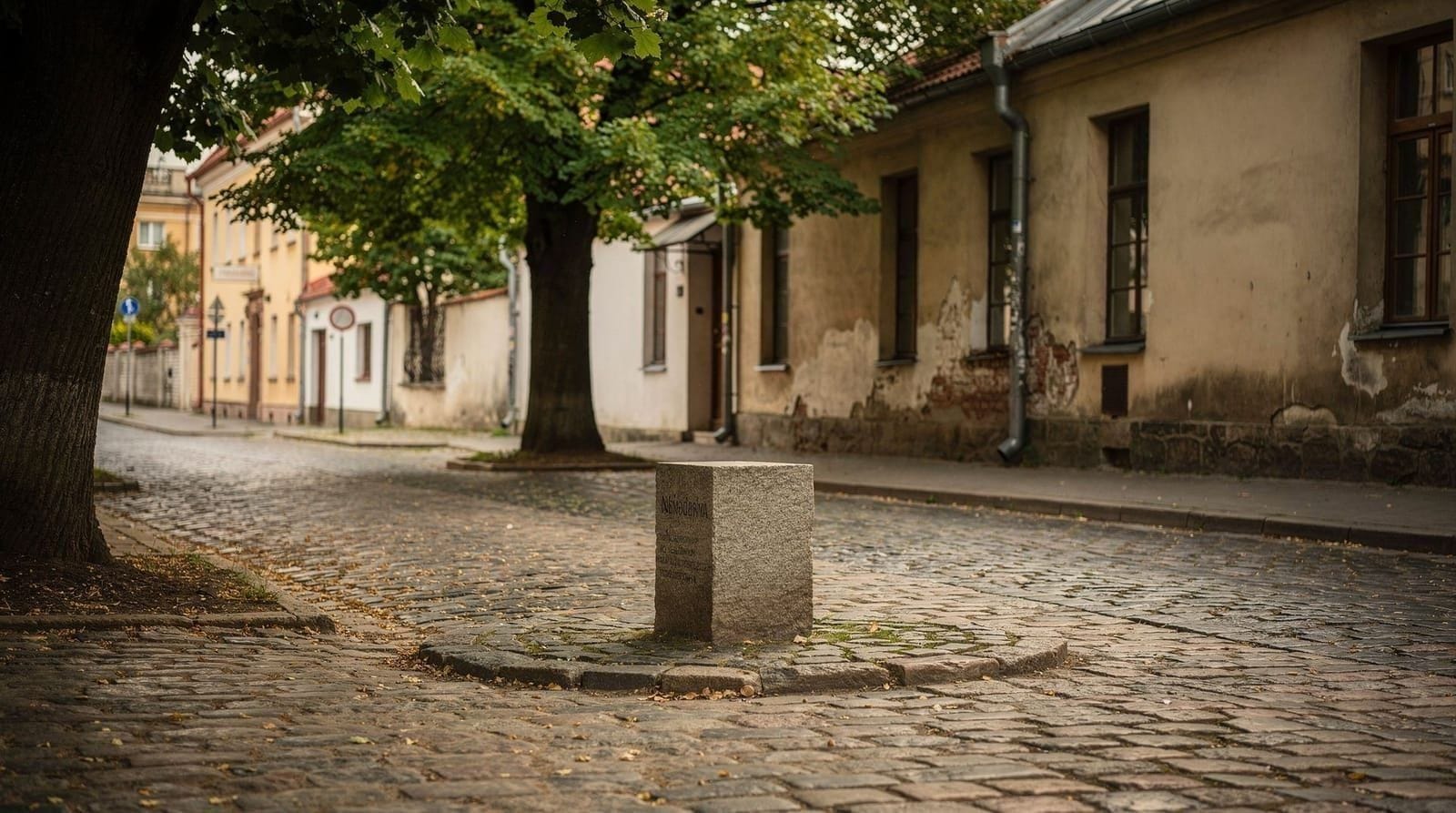
The area around Žydų gatvė (Jews’ Street), Stiklių gatvė (Glaziers’ Street), and Antokolskio gatvė (along the Vilnia river) formed the core of the Jewish district until 1941. Today these are Old Town cobblestone streets with no visible evidence of their former character — a deliberate result of both Nazi destruction and Soviet urban policy.
Walking these streets with a good map or guide and an understanding of what stood here before 1941 — the Great Synagogue courtyard, the Strashun Library (one of the great Jewish libraries of Europe, its collections scattered), the community bathing house, the printing houses of Romm — is a different experience from walking them without that knowledge.
A 2.5-hour Jewish quarter walking tour is specifically focused on the physical space of the former community and is led by guides with deep knowledge of the pre-war topography.
Paneriai: where the community was murdered
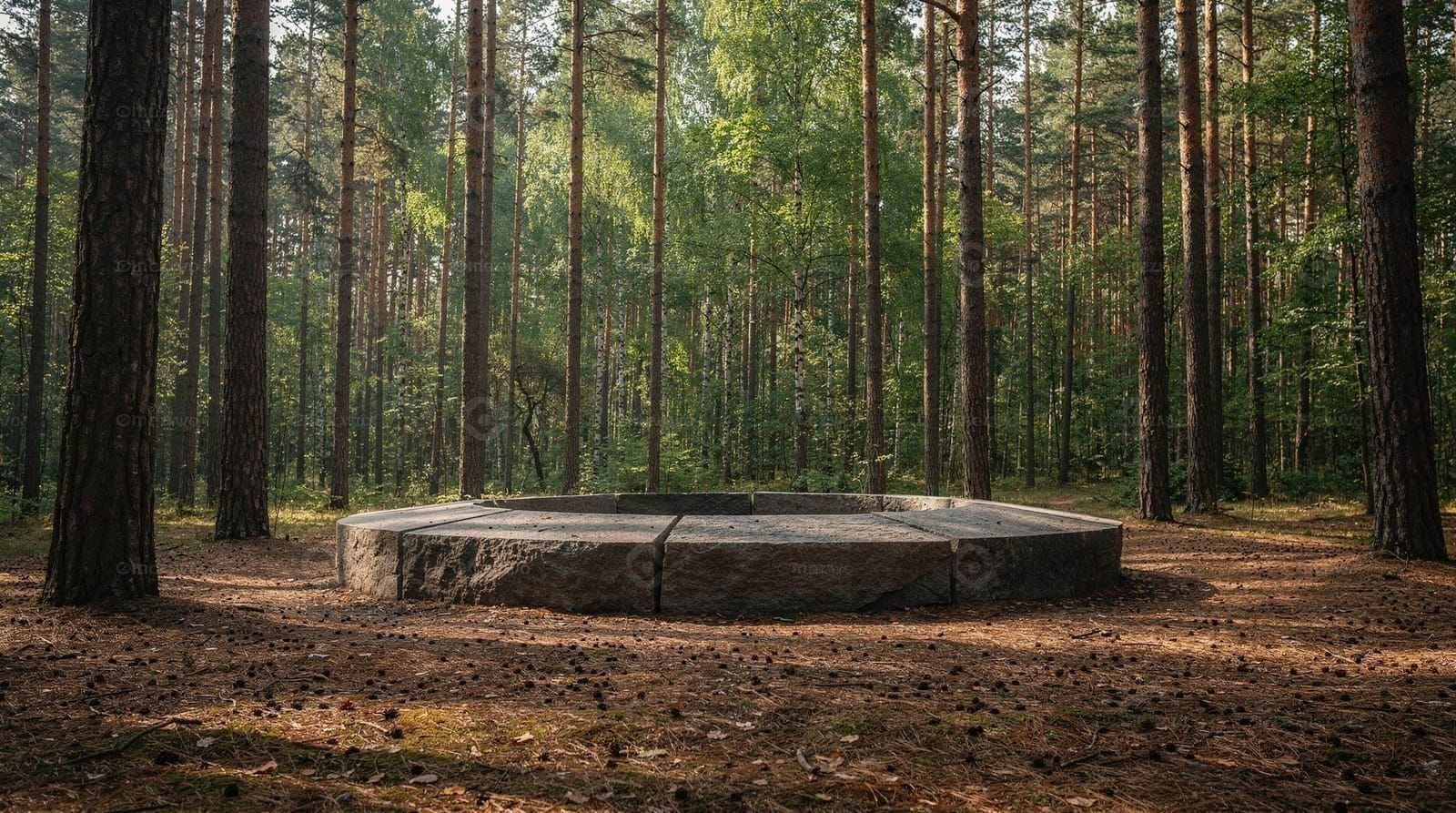
Ten kilometres from Vilnius, in the Paneriai forest, approximately 70,000–100,000 people — the majority of them Jews from Vilnius — were shot between July 1941 and July 1944. See the dedicated Paneriai Memorial guide for a full account. No account of Jewish Vilna is complete without understanding Paneriai.
The Kaunas Jewish community
The Jewish community of Kaunas (pre-war: Kovno) had its own distinct history — the temporary capital of independent Lithuania (1920–1940) had a large Jewish population associated with prominent Zionist movements, a Hebrew gymnasium, and significant cultural institutions. Approximately 37,000 Jews were murdered at the Ninth Fort in Kaunas in 1941–1944. See the Ninth Fort guide and Kaunas Jewish heritage tour for details.
A Kaunas Jewish heritage day trip from Vilnius covers the Ninth Fort and the main Kaunas Jewish heritage sites in a full-day guided itinerary.
Practical visiting information
Suggested itinerary for a day of Jewish Vilna heritage:
- Morning (2 hours): Vilna Gaon Museum main building + Green House
- Mid-morning (1.5 hours): Jewish quarter walking tour (book in advance)
- Lunch break
- Afternoon (2 hours): Great Synagogue excavation tour (by appointment)
- Late afternoon: Choral Synagogue visit (Monday–Friday only)
- Option: Afternoon or full-day trip to Paneriai (train 15 minutes)
This is a full and emotionally demanding day. Many visitors choose to spread this over two days, alternating with less intensive Old Town sightseeing.
The Jewish Community of Lithuania: jkl.lt — arranges tours, visitor information, and cultural events. English spoken at the office (Pylimo gatvė 4).
Placing Jewish Vilna within the city’s wider history
Jewish Vilna is one strand of a layered history that Vilnius documents across several distinct sites. The Vilnius Old Town guide covers the physical architecture of the streets described above — the same cobblestones, viewed through a different historical lens. Understanding the Soviet history of Vilnius also matters here, because it was Soviet urban policy, not only Nazi destruction, that erased the Great Synagogue site and rebuilt over it in the 1950s. Elsewhere in the city, the KGB Museum documents the surveillance and repression apparatus of the following decades, a separate but related layer of the same century.
Frequently asked questions about Jewish Vilnius
Why is Vilnius called the “Jerusalem of Lithuania”?
The term “Jerusalem of Lithuania” (Yerushalayim d’Lita) was applied to Vilna by Jewish scholars, acknowledging its status as a world centre of Torah study and rabbinic authority. The Great Synagogue, the Gaon’s presence, the printing presses, and the concentration of yeshivot (Talmudic academies) made Vilna a city of unique religious and intellectual weight in the Jewish world from the 17th to early 20th century.
How many synagogues were in pre-war Vilna?
At its peak in the late 19th and early 20th centuries, the Jewish community of Vilna operated over 110 prayer houses (synagogues, batei midrash, and smaller rooms). The 1939 community had 6 large synagogues plus dozens of smaller prayer spaces. All but the Choral Synagogue were destroyed during the German occupation or demolished by Soviet authorities afterward.
Are there Jewish restaurants or kosher food in Vilnius?
The Jewish Community centre at Pylimo gatvė 4 operates a small café serving traditional Ashkenazi dishes on weekday lunchtimes. There is no fully kosher restaurant in Vilnius (as of 2026), but the Jewish Community can direct visitors to Shabbat meals and other options during festival periods.
Where can I learn more about the Vilna Gaon before visiting?
The best accessible introduction in English is “The Vilna Gaon: The Story of Rabbi Eliyahu Kramer” by Eliyahu Stern (Yale University Press). For broader context on Jewish Vilna, “The Litvaks: A Short History of the Jews in Lithuania” by Dov Levin is comprehensive and available in English.
Is a guide necessary, or can I visit these sites independently?
The Vilna Gaon Museum, Choral Synagogue, and the general area of the former Jewish quarter can all be visited independently — opening hours and locations are straightforward. A guide adds the most value at the Great Synagogue archaeological site, which is only accessible via organised tours, and for understanding what stood on the now-unmarked streets of the former quarter, where a knowledgeable guide brings the pre-war topography to life in a way self-directed walking cannot.
How does a visit to Jewish Vilnius connect with Paneriai and Kaunas?
They form a natural sequence rather than separate excursions. The Vilna Gaon Museum and Old Town sites explain what the community was; Paneriai explains how it was destroyed; and the Kaunas Jewish heritage sites show that this history was not unique to Vilnius but repeated across Lithuania’s Jewish communities. Visiting all three, even across separate days, gives a far fuller picture than any one alone.
Top experiences
Bookable activities with verified prices and instant confirmation on GetYourGuide.