Trakai hot air balloon flight: which experience to book
Trakai: Hot air balloon ride
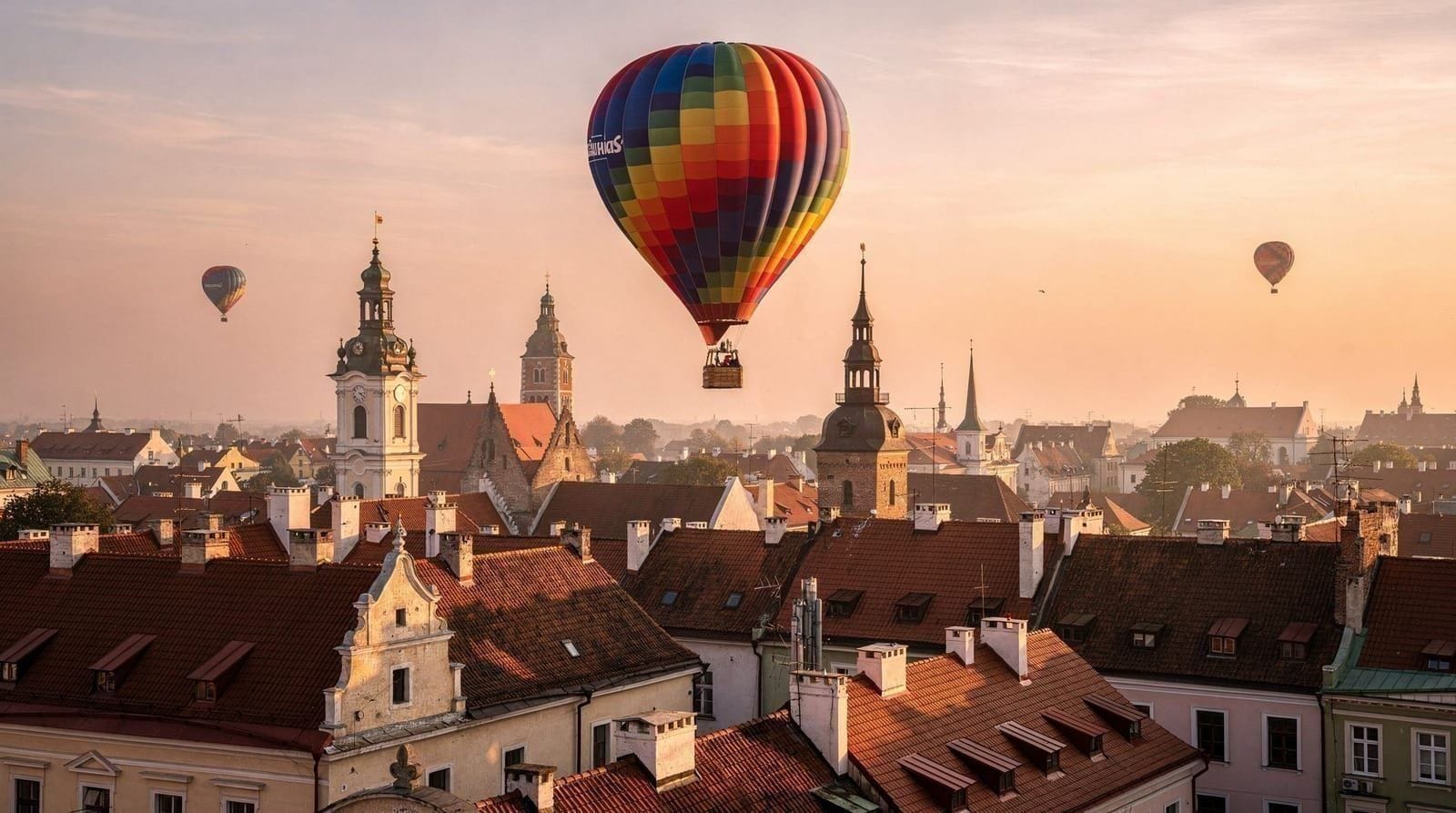
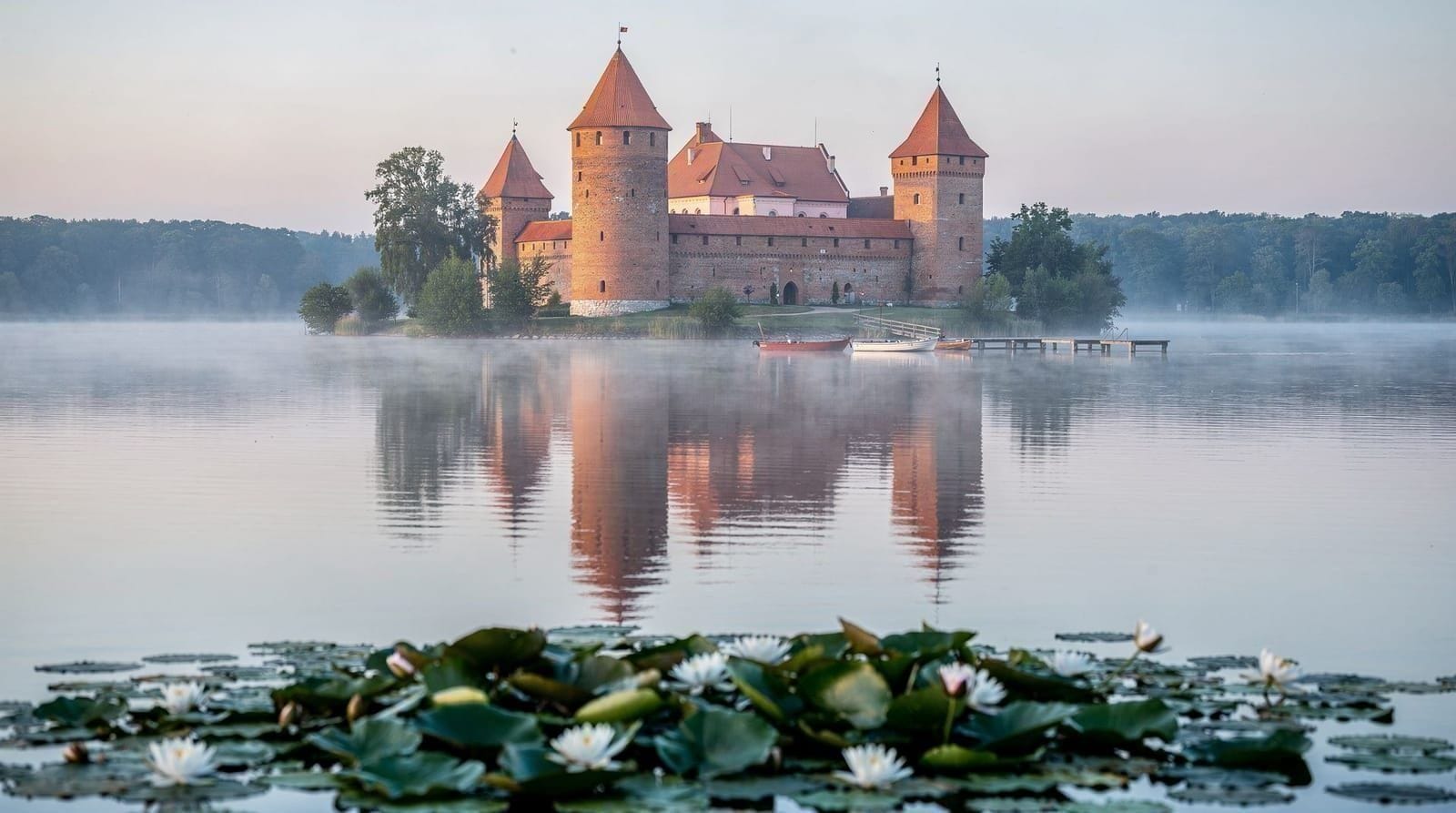
Lithuania’s flat, lake-dotted landscape makes it one of the better places in Europe for hot air ballooning. The view from altitude across Trakai’s lake system — with the red-brick castle visible on its island — is a legitimately impressive photograph and experience. Vilnius’s low-rise cityscape, surrounded by forest, also reads well from above. The question is which operator format suits your timing and budget.
| Where | Trakai (30 km from Vilnius) or Vilnius outskirts, wind-dependent |
| Cost | Around €120–€180 per person depending on transfer and format |
| Time needed | 3–4 hours total including briefing, flight and champagne ceremony |
| Best time to fly | Sunrise (6:00–8:00) or evening (19:00–21:00) when wind and thermals are calmest |
| Booking | Book early in your trip — weather cancellations mean a single scheduled morning can fail |
Balloon flight based in Trakai
The Trakai hot air balloon ride is based out of Trakai and offers the most direct route to the castle-and-lake aerial perspective. You meet the crew at Trakai (about 30 km from Vilnius), attend the pre-flight briefing, help with the balloon inflation if you choose, and fly for approximately 60 to 90 minutes. Landing location depends on wind direction — this is standard for ballooning; you chase the balloon by vehicle and collect passengers at the landing site.
The post-flight ceremony includes champagne (or non-alcoholic alternative) by Lithuanian ballooning tradition. Certificates of flight are usually issued.
Who this suits: Visitors who are already going to Trakai for the castle and want to combine the two. Combining a morning castle visit with an afternoon or early evening balloon flight works well — balloon launches are best at sunrise (6:00–8:00 in summer) or in the evening (19:00–21:00) when thermal activity is lowest and wind is calmest.
Important note on sunrise vs evening flights: Operators typically offer both slots. Sunrise flights mean a very early morning, but the light quality is exceptional and thermals are minimal. Evening flights allow a later start but risk weather deterioration as the day progresses. If you have a choice, sunrise in June or July (when light begins around 4:30) is remarkable. See the hot air ballooning guide for Vilnius for more on timing.
Vilnius-area balloon with hotel transfer
The Vilnius hot air balloon ride with hotel transfer is the most convenient format for visitors based in Vilnius who do not have their own transport. The operator includes a hotel pickup from central Vilnius, drives you to the launch site (which may be on the outskirts of Vilnius or toward Trakai depending on wind conditions that day), and returns you afterward.
This is worth the slight premium over the base Trakai option if you do not have a car. Ballooning logistics — early morning starts, remote landing sites — are significantly easier with an included transfer. You are not scrambling for a taxi at 5:30 am or trying to arrange your own transport to an unknown field.
What to check: Confirm exactly what the hotel transfer covers — some operators mean “central Vilnius” very broadly and may require you to reach a specific pickup point. Ask at booking.
The Vilnius or Trakai flexible option
The Vilnius or Trakai hot air balloon flight is offered by operators who can launch from either location depending on weather, wind direction, and group demand on the day. This is logistically sensible for the operator and gives you a confirmed flight booking without the fixed launch site — meaning if Trakai conditions are not right, you fly over Vilnius instead.
For most visitors, this flexibility is an advantage: you get your balloon flight rather than a cancellation. If the specific Trakai castle view is critical to you (a proposal flight, a specific photography project), this open-ended format may frustrate. In that case, book the dedicated Trakai option and accept higher cancellation probability.
Format and price comparison
| Trakai ride | Vilnius with transfer | Vilnius/Trakai flexible | |
|---|---|---|---|
| Launch location | Trakai | Vilnius outskirts | Varies |
| Transfer included | No | Yes | Check operator |
| Flight duration | 60–90 min | 60–90 min | 60–90 min |
| Total time | 3–4 h | 3–4 h | 3–4 h |
| Approx. price/person | €120–€150 | €140–€180 | €120–€160 |
| Best for | Trakai visitors | City-based guests | Flexibility priority |
What the flight experience is actually like
Pre-flight at a balloon launch takes 30 to 45 minutes. You watch the inflation process (the balloon is laid flat, cold air is blown in with a large fan, then the burners fire to heat the air — a dramatic sequence that takes 15–20 minutes). Passengers are invited to assist if they wish — holding fabric guide ropes, helping position the basket. The briefing covers safety protocol, the landing approach, and what to expect during the flight.
The ascent is almost entirely silent except for the occasional burst of the burners. There is no wind sensation — you move with the wind, so it feels still. The sound of the burner firing is about the level of a loud propane heater: not quiet, but not distressing. Between burns it is completely silent at altitude.
The landscape around Vilnius and Trakai from 300 to 500 metres is predominantly forest — Lithuania is heavily wooded — with the lake system and castle visible on flights over the Trakai area. The Vilnius Old Town, when visible on city-side flights, shows its Baroque roof profile clearly. At altitude, the scale of the city’s surrounding forest becomes apparent — Vilnius has one of the highest ratios of green space to urban area of any European capital.
Landing is the most variable part: the pilot guides the basket down in a descending spiral, and the chase vehicle has followed on the ground. Landing sites are typically fields or clearings; it is not always smooth. Passengers should be prepared to bend their knees and grip the basket handles. It is rarely more than a gentle bump.
The champagne ceremony afterward is a legitimate tradition — it dates from the earliest days of ballooning in 18th-century France, where it was used to reassure startled farmers that the aeronauts were friendly. In modern practice it takes 20 to 30 minutes, the certificate is issued, and then you are returned to Vilnius or Trakai by the chase vehicle.
Honest considerations before booking
Weather cancellations: In Lithuania, the flying window in any given week can be limited. Operators will reschedule or refund when weather prevents flying, but if you have a fixed departure date and only one available morning, you risk not flying at all. Book early in your trip rather than saving it for the last day.
Physical requirements: Standard balloon passenger basket requires standing for 60 to 90 minutes. The basket walls are typically chest height. Most operators have a maximum weight limit (around 100 kg per person) and cannot accommodate people who cannot stand unsupported. Confirm your specific requirements at booking.
Children: Many operators require minimum age of 7–8 years and that children are tall enough to see over the basket. The experience is safe and genuinely exciting for children who are comfortable with heights.
Champagne tradition: The post-flight champagne ceremony is a European ballooning tradition. Operators typically offer apple juice or similar for non-drinkers and children.
Vilnius from altitude: what you see on a city flight
For balloon flights that take off from the Vilnius outskirts or the suburbs between Vilnius and Trakai, the aerial perspective is distinct from what you see on the ground.
The most striking feature from altitude is the sheer density of forest immediately surrounding the city. Vilnius has the highest ratio of forested area to urban area of any EU capital — the forest comes right to the edge of residential districts, and from above this reads as a green carpet interrupted by the city rather than a city surrounded by parkland. On clear days, the Neris River meanders through the Old Town visible from altitude, with the Cathedral’s white neoclassical bulk and the red-brick mass of Gediminas Castle Hill clearly identifiable.
The Soviet housing estates (microrayony) are visible to the north and east of the Old Town — the standardised panel-construction apartment blocks that housed the rapidly expanded Soviet-era population. From altitude, the contrast between the organic medieval street plan and the rigidly geometric Soviet blocks is particularly clear.
In the Trakai direction, the lake system becomes apparent around 20 minutes into the flight — a series of connected lakes in glacially carved basins, the castle island visible as a red brick structure on a peninsula in the middle lake. Depending on wind direction, the flight might approach Trakai from the west (over the pine forest) or from the east (over the agricultural plain).
The pilot will point out key landmarks as you cross them. Conditions permitting, you can photograph with a standard smartphone — stabilisation is sufficient at altitude even without a tripod. The basket is stable enough for photography, and the light quality at sunrise or golden hour is excellent.
Fitting a balloon flight into your Vilnius trip
Sunrise flights require significant logistics planning — particularly if you are arriving that day or leaving the following morning. The ideal structure is: book the balloon flight on day two or three of a 3-day Vilnius and Trakai itinerary, combining with the castle visit. On a 5-day trip, there is more flexibility to wait for a good weather window.
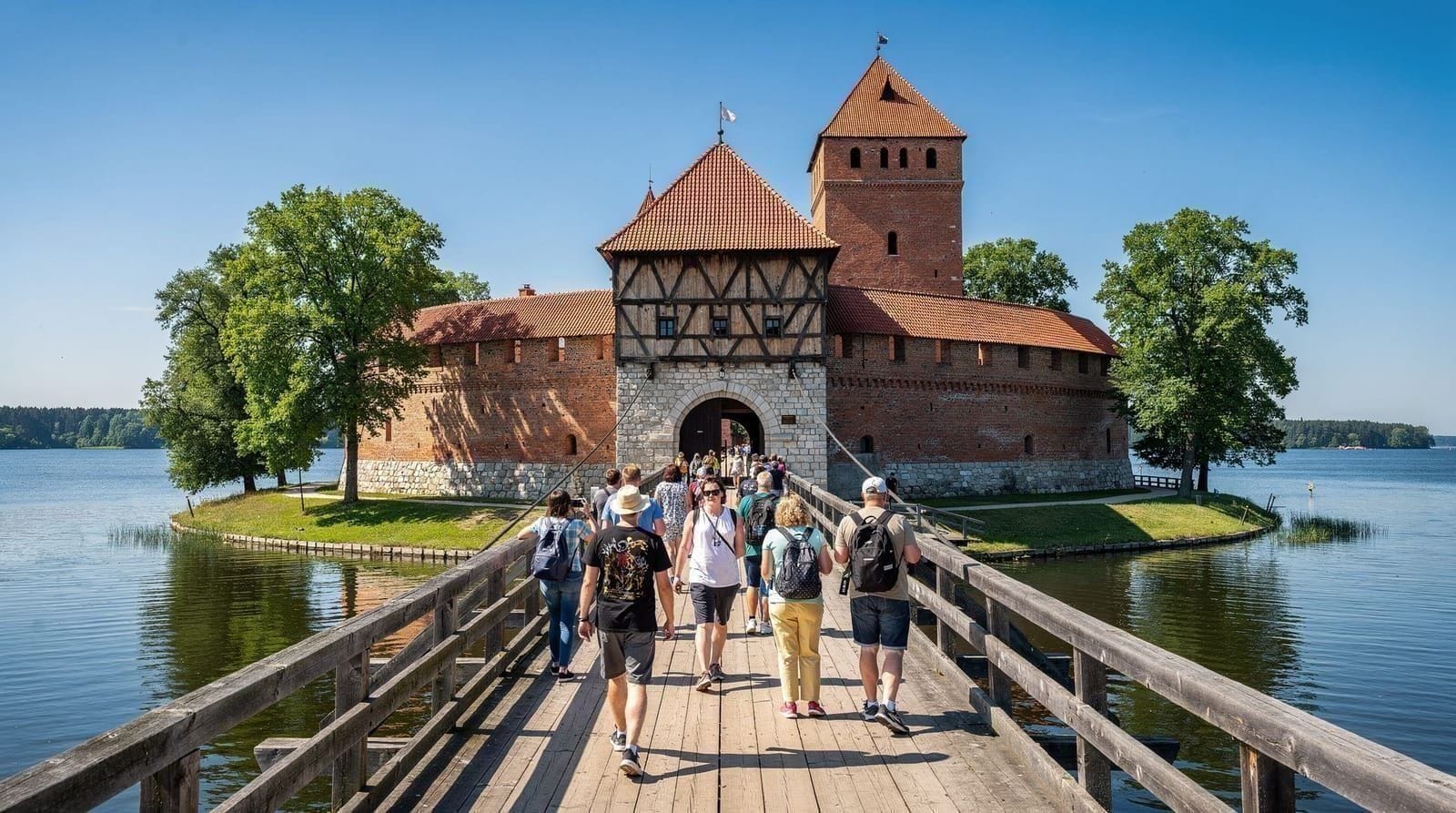
If you are combining with a Trakai castle visit, the Trakai Castle tour page covers the ground-level options for the same day. The Trakai destination page and best day trips guide position both within the broader Lithuania itinerary.
Timing your flight with Trakai Castle visit
The most natural combination is: morning at Trakai Castle (opens at 10:00), lunch in the village (kibinai at Kibinine restaurant on Karaimų Street, around €3–€5 per pastry), then an evening balloon flight starting at 19:00–20:00 in summer. This requires either your own transport or a private tour that can hold you in Trakai through the day.
If you are on a group tour to Trakai Castle (which typically returns to Vilnius by early afternoon), the logistics of staying for an evening balloon flight require booking the flight separately and arranging your own Trakai accommodation or late return transport. Not impossible, but requires planning.
Sunrise flights from Trakai work best if you spend the night in Trakai (guesthouses start at €40/night in the village) and accept the 5:00–6:00 am start time. This is the enthusiast’s choice — the early light on the castle and lake is exceptional — but it requires committing to a Trakai overnight.
For visitors based in Vilnius without their own car, the balloon flight with hotel transfer is more practical than the dedicated Trakai launch, specifically because the transfer removes the logistics of early morning or late evening travel to Trakai.
The premium option: champagne and snacks flight
For a special occasion — a proposal, an anniversary, a milestone birthday — the hot air balloon flight with champagne and snacks builds a more considered food and drink element into the post-flight ceremony rather than the standard single glass. It costs a premium over the base flight formats but suits visitors who want the experience to feel like an event rather than simply a flight. Book this format specifically if the ceremony matters to you as much as the flight itself.
Seasonal flying conditions around Vilnius and Trakai
| Season | Flying conditions | What you see | Notes |
|---|---|---|---|
| June–August | Best light, calmest evenings; sunrise starts around 4:30–5:00 | Green forest canopy, lake system at its clearest | Peak season pricing; book well ahead |
| April–May, September–October | Good, slightly more variable wind | Spring blossom or autumn forest colour | Often the best value-for-light trade-off |
| November–March | Limited flying windows, more cancellations | Snow-covered forest and frozen lake sections possible | Fewer operator departures; confirm availability before planning around it |
For the broader seasonal picture of what Vilnius and Trakai look like on the ground at each time of year, see the Vilnius in summer guide and the Vilnius in spring and autumn guide.
Photographing the flight and the view
A hot air balloon flight is one of the more reliable ways to get a genuinely different photograph of Vilnius and Trakai than the standard ground-level shots. The best views in Vilnius guide covers ground-based viewpoints for comparison, and the Vilnius Instagram spots guide is a useful reference if you are specifically chasing photogenic angles rather than just enjoying the flight. From altitude, the contrast between Vilnius’s Baroque Old Town roofscape and the surrounding forest is one of the more distinctive views available from any European capital.
Frequently asked questions about hot air balloon flights near Vilnius
What happens if the flight is cancelled due to weather?
Reputable operators offer a full refund or rebook option. Weather cancellations are not unusual — Lithuania’s flat landscape makes it sensitive to wind changes. Booking operators with clear weather cancellation policies (and who do not charge fees for weather-related reschedules) is important. Check reviews for how operators handle this before booking.
Is a balloon flight over Vilnius Old Town possible?
Yes — some Vilnius-area flights cross over the Old Town. This is highly dependent on wind direction and is not guaranteed. The view from altitude over the Baroque roofscape is excellent if the flight path allows it.
How high do balloons fly?
Typically 300 to 800 metres above ground, though this varies considerably depending on thermals, clouds, and the pilot’s judgement. The highest point might be 1,500 metres; cruise altitude during photo-friendly conditions is usually lower.
Are balloon flights available in spring and autumn?
Yes — April/May and September/October offer good flying conditions. The landscape is beautiful in autumn (forest colours) and spring (flowering meadows). Peak season pricing applies June through August.
Is it safe?
Ballooning is statistically very safe under licensed operators. Lithuanian balloon operators must be licensed and meet EU safety requirements. Check that your operator is ILTA (Lithuanian Aeronautical Association) licensed and flying modern certified equipment. Avoid operators with vague safety information.
Can I combine a balloon flight with Vilnius’s green spaces on the ground?
Yes — the forest that surrounds Vilnius and is so visible from altitude is also walkable at ground level. The Vilnius parks and green spaces guide covers the forest parks that ring the city, which make a pleasant, unhurried complement to a flight if you have a free morning or afternoon around your booking.