St. Anne's and Bernardine churches — Vilnius's Gothic masterpiece
Vilnius: City highlights walking tour
Duration: ~2 hours
What is special about St. Anne's Church in Vilnius?
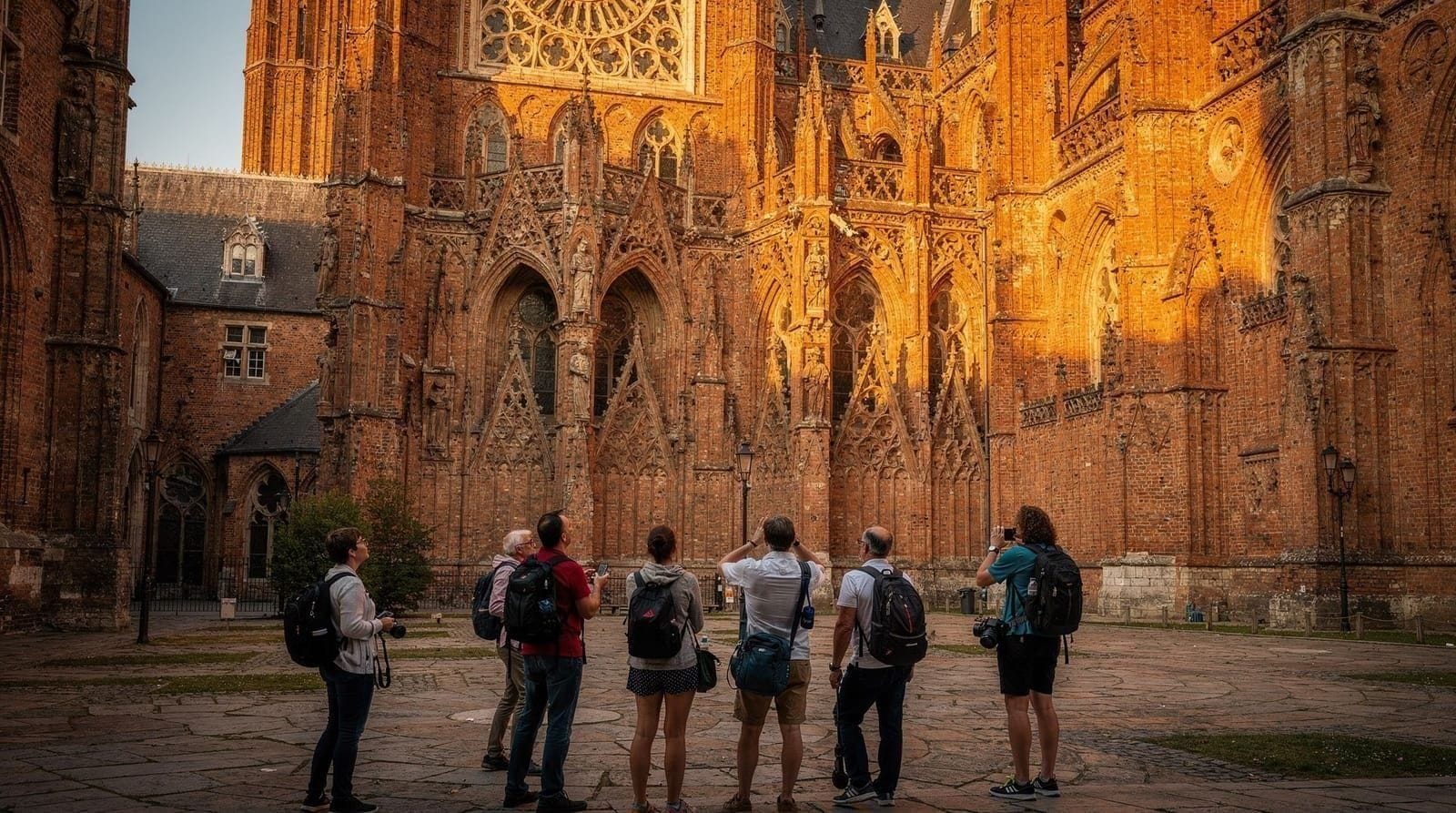
St. Anne's Church is a remarkably intact Flamboyant Gothic church dating from the late 15th to early 16th century, built from 33 different types of brick in 22 patterns. It is the visual symbol of the eastern end of the Old Town, and one of the finest Gothic brick buildings in northern Europe.
The southeastern corner of the Vilnius Old Town, where the medieval street grid opens onto the Vilnia River, contains the most architecturally striking view in the city: the twin spires of St. Anne’s Church rising in deep-red and pale-pink brick against the green Bernardine Garden and the river valley beyond. This is the image of Vilnius that appears on postcards, guidebooks, and tourist websites, but the physical reality is better than the photographs.
| Where | Maironio gatvė, eastern edge of the Old Town |
| Cost | Free entry to both churches and the garden |
| Time needed | Around 40–60 minutes for both churches and the garden |
| Getting there | 10-minute walk from Pilies gatvė, or 3 minutes from the Užupis bridge |
| Best time | Morning (8–10 am) for warm light on the brick facade |
St. Anne’s Church: the architecture
St. Anne’s Church (Šv. Onos bažnyčia, Maironio gatvė 8) is a Flamboyant Gothic church built approximately 1495–1516. The facade is built from 33 different types of specially moulded brick — not standard bricks but custom-shaped units designed to create the flowing curves, tracery, and pinnacles of the Gothic vertical style. The brickwork was laid in 22 different patterns. This is not unusual by the standards of Flemish or North German brick Gothic, but it is exceptional in the Lithuanian context.
The facade is structured as a series of rising vertical elements: three doorway arches at street level, niches above them, then a middle tier of window tracery, then the upper tier of open tracery and finally the two asymmetrical spires — one slightly taller, giving the facade a subtle dynamism. The overall height is 22 metres. The colour ranges from deep terracotta to pale pink depending on the angle of light, which is why the church looks different in morning and afternoon photography.
Interior: significantly simpler than the exterior. The single-nave Gothic interior with painted stellar vaults dates mostly from the 17th century remodelling. The altars are Baroque additions from different periods. The main interest inside is the structure itself — the proportion of nave to vault height, the ribbed vaulting, and the quality of the stonework — rather than the furnishings. Photography is permitted.
Architectural identity and the Napoleon legend
The Napoleon anecdote — that he wished to carry the church to Paris in the palm of his hand — circulates in virtually every Vilnius guidebook. It makes a pleasing story and is not impossible (Napoleon did pass through Vilnius twice, in June and December 1812), but no documented source from the campaign records such a statement. The 1812 December retreat through Vilnius was catastrophic, with the Grande Armée in collapse — not a moment likely to inspire aesthetic admiration. The legend probably originated in the 19th century as a way of establishing Vilnius’s cultural prestige under Tsarist rule.
What is documented: French soldiers did use the Bernardine Church complex as a hospital and stable in 1812. Some damage to the churches dates from this period.
History and use
The church was built on the site of an earlier wooden chapel dedicated to St. Anne. The patron was likely Grand Duke Alexander Jagiellon, who had strong personal devotion to St. Anne. It served the Catholic Lithuanian and Polish community of the city.
During the Tsarist period (1795–1918), the church was closed between 1844 and 1921 — Russian imperial policy restricted Catholic worship as part of broader pressure on Polish-Lithuanian culture after the 1830 and 1863 uprisings. The building was used as a Russian Orthodox church and then as a warehouse. The damage from this period was repaired during the interwar Polish administration of Vilnius (1920–1939).
During Soviet rule, St. Anne’s was again repurposed — as a gallery space — and the congregation was dispersed. It was returned to Catholic use in 1989.
The Bernardine Church
The Church of St. Francis and St. Bernard (Bernardinų bažnyčia, Maironio gatvė 10) stands directly adjacent to St. Anne’s, sharing a narrow passage between them. It is significantly larger: a Gothic church with a long nave, Renaissance extensions, and Baroque tower additions, built across the 15th–18th centuries.
The Bernardine monastery was one of the most important Franciscan houses in the Grand Duchy. The complex housed a major printing establishment in the 16th century, and several significant intellectual figures of the Lithuanian national revival are associated with the monastery’s library.
Interior highlights:
- The late Gothic stone tracery in the windows of the nave, partially original
- Baroque side altars, the most complete set from a single period surviving in Vilnius’s Franciscan churches
- Wall paintings in the nave aisles, some dating to the 16th century (restored in the 1970s and 2000s)
- A separate chapel of the Holy Cross with 17th-century carved altar
The church is open daily 10 am–5 pm. Entry is free.
The Bernardine Garden
Between the Bernardine Church and the Vilnia River, the Bernardine Garden (Bernardinų sodas) is a landscaped public park open daily from dawn to dusk. It was a monastery garden through the 17th and 18th centuries, became a public park under the Tsarist administration, and was heavily restored in 2011–2014.
The garden has sculptures referencing the four seasons, benches with river views, and a small amphitheatre area used for outdoor events. It is a pleasant 15-minute stop and the best outdoor seating in the immediate area. No food vendors operate inside, but cafés on Maironio gatvė are steps away.
The garden connects visually to the Užupis district on the opposite bank — the bridge at the eastern end of the garden is one of the access points to the Užupis Republic. See the Užupis guide for details.
The Old Arsenal and Anne’s Square (Onos aikštė)
The small square in front of St. Anne’s Church (technically Onos aikštė) frames the church facade with the Old Arsenal building on the left — a Renaissance-period building now housing the Lithuanian National Museum’s exhibition on Lithuanian statehood.
The view from this small square — St. Anne’s facade, Bernardine tower rising behind, Gediminas Hill visible in the background — is the most photographed angle in Vilnius. Morning light (before 10 am) gives warm illumination on the red brick; late afternoon gives a deeper reddish tone. Midday light is flat.
An Old Town walking tour that covers this corner of the Old Town typically includes 15–20 minutes of detailed architectural explanation of the Gothic brick techniques — hard to appreciate without guidance if you do not have an architectural background.
Practical visiting information
St. Anne’s Church: Maironio gatvė 8. Open Tuesday–Sunday 10 am–5 pm. Free entry. Closes during services (call ahead for times: +370 5 261 1586).
Bernardine Church: Maironio gatvė 10. Open daily 10 am–5 pm. Free entry.
Getting there: 10-minute walk east from the northern end of Pilies gatvė (turn right at Šv. Ono gatvė and follow signs). Or a 3-minute walk from the Užupis bridge.
Combined visit duration: 40–60 minutes for both churches and the garden.
Cafés nearby: Café de Paris on Maironio gatvė 13 (French-run, excellent coffee, €2.80–3.50, reliable). Žemaičiai at Vokiečių gatvė 24 (Lithuanian home cooking, cepelinai €7, closed Sunday).
Gothic brick versus Vilnius’s Baroque skyline
St. Anne’s is the best place in the city to understand what came before the Baroque wave that later defined Vilnius. Most of the Old Town’s church interiors — and many facades — were rebuilt or added to in the 17th and 18th centuries, which is why the Vilnius Baroque architecture guide covers a very different visual language: white plaster, undulating cornices, and dramatic sculpture. Seeing St. Anne’s brick tracery first makes the contrast at churches like St. Casimir’s or the Baroque interiors elsewhere in the Old Town guide much easier to read. If you only have time for one architectural comparison in Vilnius, this pairing is the clearest.
How this corner fits a wider Old Town walk
St. Anne’s sits at the natural eastern hinge of the Old Town, between the university quarter and Užupis. Most visitors reach it on foot from Vilnius University via Pilies gatvė and Šv. Ono gatvė, then continue across the river into Užupis — a loop that takes half a day at an unhurried pace. Folk tradition around the church and the wider Old Town is covered in the Vilnius legends and myths guide, which includes several stories tied to this stretch of the river. For getting to this part of town from elsewhere in Vilnius, see the getting around Vilnius guide.
A Vilnius courtyards and architecture walking tour is a good option if you want the Old Town’s hidden architectural details explained beyond just this corner.
Frequently asked questions about St. Anne’s and Bernardine churches
How many brick types does St. Anne’s Church really use?
33 is the standard figure, derived from 19th-century architectural surveys. Each type was custom-moulded to create specific curved, pointed, or folded shapes required by the Flamboyant Gothic design. Recreating the brick moulds for restoration work has been one of the main technical challenges.
Is St. Anne’s Church a Gothic or Baroque building?
Gothic — specifically Flamboyant Gothic, the late-medieval phase of the style. The Baroque elements (some interior furnishings, the small chapel added on the north side) are additions and modifications. The main church structure and especially the facade are purely Gothic.
Can you get married at St. Anne’s Church?
Yes. St. Anne’s is an active Catholic parish and conducts weddings by arrangement. Contact the parish office at the address above. Saturdays from May to October are heavily booked; check availability well in advance.
What is the best time of day to photograph St. Anne’s Church?
The morning light from the east hits the facade directly from about 8–10 am in summer, giving the warmest red-brick tones. Late afternoon provides side lighting that emphasises the three-dimensional tracery. The church is lit at night from about 9 pm onward in summer.
Is St. Anne’s Church worth visiting if I only have one day in Vilnius?
Yes — even a single day in the Old Town should include the short walk to Onos aikštė for the view alone, since it takes well under an hour combined with the Bernardine Garden. It pairs naturally with a short crossing into Užupis if time allows.
Do I need to book to visit St. Anne’s or the Bernardine Church?
No booking is required for either church or the garden — all three are free, walk-in attractions during opening hours. Only weddings and special services need advance arrangement.
Top experiences
Bookable activities with verified prices and instant confirmation on GetYourGuide.