Vilnius University — visiting the courtyards and church
Vilnius: City highlights walking tour
Duration: ~2 hours
Can you visit Vilnius University as a tourist?
Yes. The 13 interconnected courtyards are open to the public daily 9 am–6 pm (shorter hours on weekends). Entry to the courtyards costs €1.50 suggested donation. The Church of St. Johns is free. The university tower has views over the Old Town for €4.
| Where | Šv. Jono g., a 2-minute walk from Cathedral Square |
| Cost | €1.50 suggested donation for courtyards; church free |
| Time needed | 45-75 minutes, plus 20 for the bell tower |
| Getting there | Walk from anywhere in the Old Town |
| Best time | Weekday mornings outside exam periods (Jan, June) |
Vilnius University is one of those places where the physical reality exceeds the expectation. From the street, the university announces itself modestly through an arched gate on Šv. Jono gatvė. Step through and you enter a sequence of connected courtyards spanning more than four centuries of architectural ambition — Gothic foundations, Renaissance arcades, Baroque church facades, and Enlightenment-era scientific instruments all coexisting in a surprisingly compact space that still functions as an active, working university.
History in brief
The Jesuits founded the university in 1579, under the patronage of King Stefan Bathory of the Polish-Lithuanian Commonwealth. Its formal role was to counter the spread of Protestantism in the region, which had made significant inroads in Lithuanian noble families through the mid-16th century. Within a generation, the university had become the leading intellectual institution of the Grand Duchy.
The university’s first two centuries were turbulent but productive. It ran a printing press from the 1580s, published works in Lithuanian, Polish, Latin, and Belarusian, and attracted scholars of European reputation. It was suppressed during the Tsarist occupation in 1832 — a direct political response to the November Uprising of 1830–31, when Lithuanian and Polish students and intellectuals participated in the rebellion against Russian rule. The university was closed for nearly 70 years.
It reopened in 1919 as a Polish university (Wilno was under Polish control 1920–1939), and became Lithuanian Vilnius University again in 1940 after Soviet and then German occupations, finally functioning as a fully Lithuanian institution from 1945 onward. Soviet academic culture left marks on the institution that the post-1990 generation has actively worked to address.
Today the university has around 19,000 students and remains Lithuania’s most prestigious institution. The historic complex in the Old Town is part of the active campus — students study in buildings that date back to the 16th century.
The courtyards: a self-guided route
There are 13 named courtyards in the historic complex. You will not exhaust them in a single visit, but the following five are the most architecturally significant.
The Great Courtyard (Didysis kiemas)
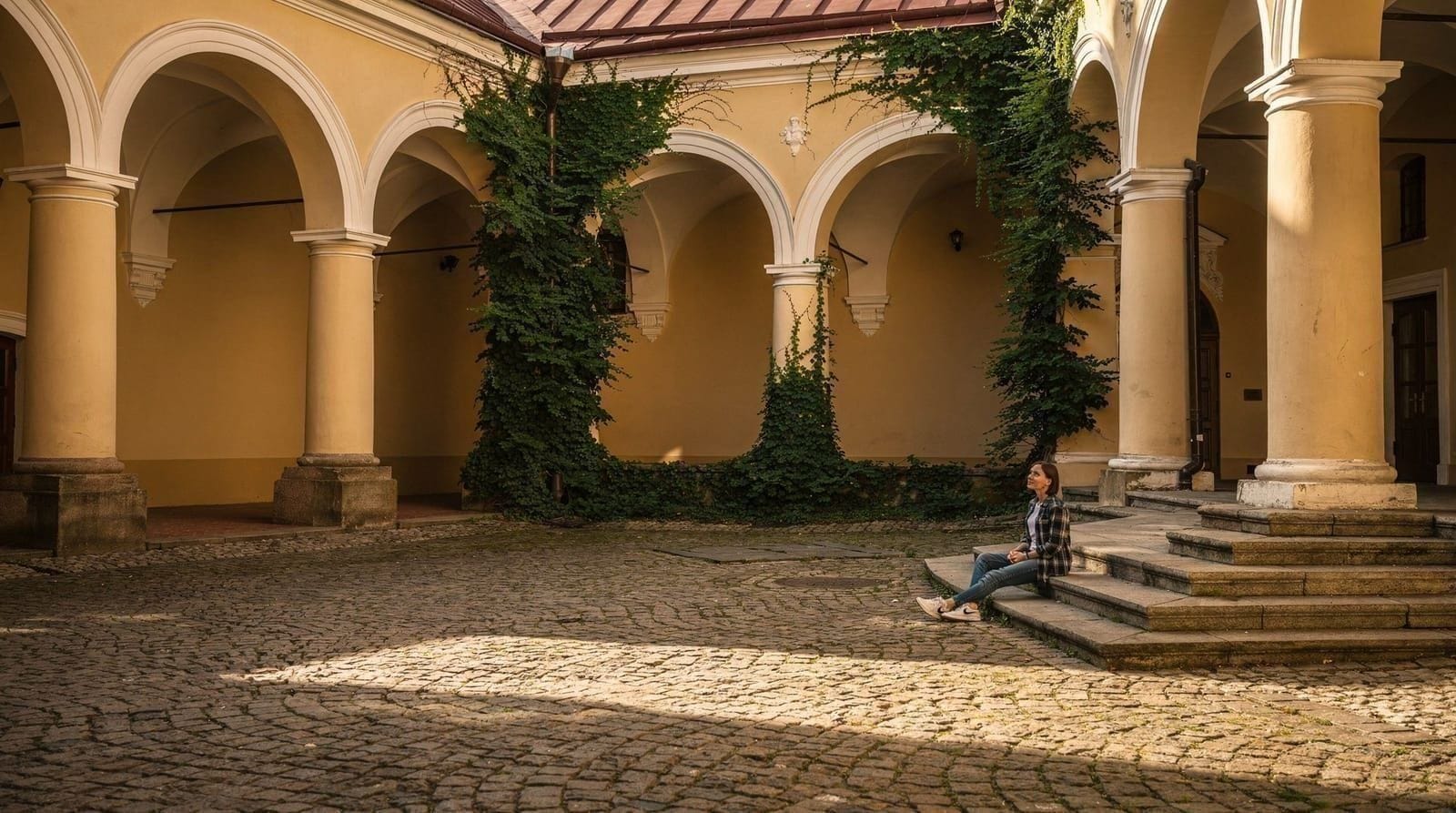
The main entrance from Šv. Jono gatvė leads directly into the Great Courtyard. The enclosed square of two-storey Renaissance arcades is the centrepiece of the complex, and the proportions are excellent — well-balanced, with enough space to feel grand without being overwhelming.
The Church of St. Johns (see below) occupies the north side. On the remaining three sides, the arcade columns carry sunken reliefs and inscriptions — look for the panels commemorating specific professors and benefactors.
The well in the centre of the courtyard is original 16th century. It still has water but is no longer used.
The Observatory Courtyard (Observatorijos kiemas)
Reached through a passage on the south side of the Great Courtyard, this smaller courtyard is built around the former astronomical observatory constructed in 1753. The facade of the observatory carries carved zodiac symbols, astronomical instruments, and allegories of Geometry and Astronomy — the level of Baroque sculptural detail here is equal to the best church decoration in Vilnius, yet most visitors walk past without stopping.
The observatory was one of the most advanced in 18th-century Europe, directed by Martin Poczobut (Martynas Počobutas), who corresponded with French and British scientists and made original observations. The instruments inside are no longer accessible to visitors, but the building and courtyard can be photographed freely.
The Sarbievijaus Courtyard
A smaller, more intimate space named after the Baroque poet Maciej Sarbiewski, who studied and taught here in the early 17th century. Sarbiewski was known across Europe as the “Christian Horace” — his Latin poetry went through over 50 editions in his lifetime.
The courtyard has a slightly different atmosphere from the others — quieter, with an access door to the old library collections. Worth 10 minutes.
The Philology Courtyard (Filologijos kiemas)
The courtyard connecting the main complex to the southern section of the university. Literary quotations from Lithuanian, Polish, Latin, and other languages in which students here have written over the centuries are carved into the connecting corridor walls. A deliberate commemoration of the multilingual scholarly tradition.
The Little Courtyard (Mažasis kiemas)
The smallest of the main courtyards, with an entrance on Universiteto gatvė. Stone stairs, ivy on the walls, benches. Students eat lunch here. Often empty of tourists. One of the most pleasant spots in the Old Town for quiet sitting.
The Church of St. Johns (Šv. Jonų bažnyčia)
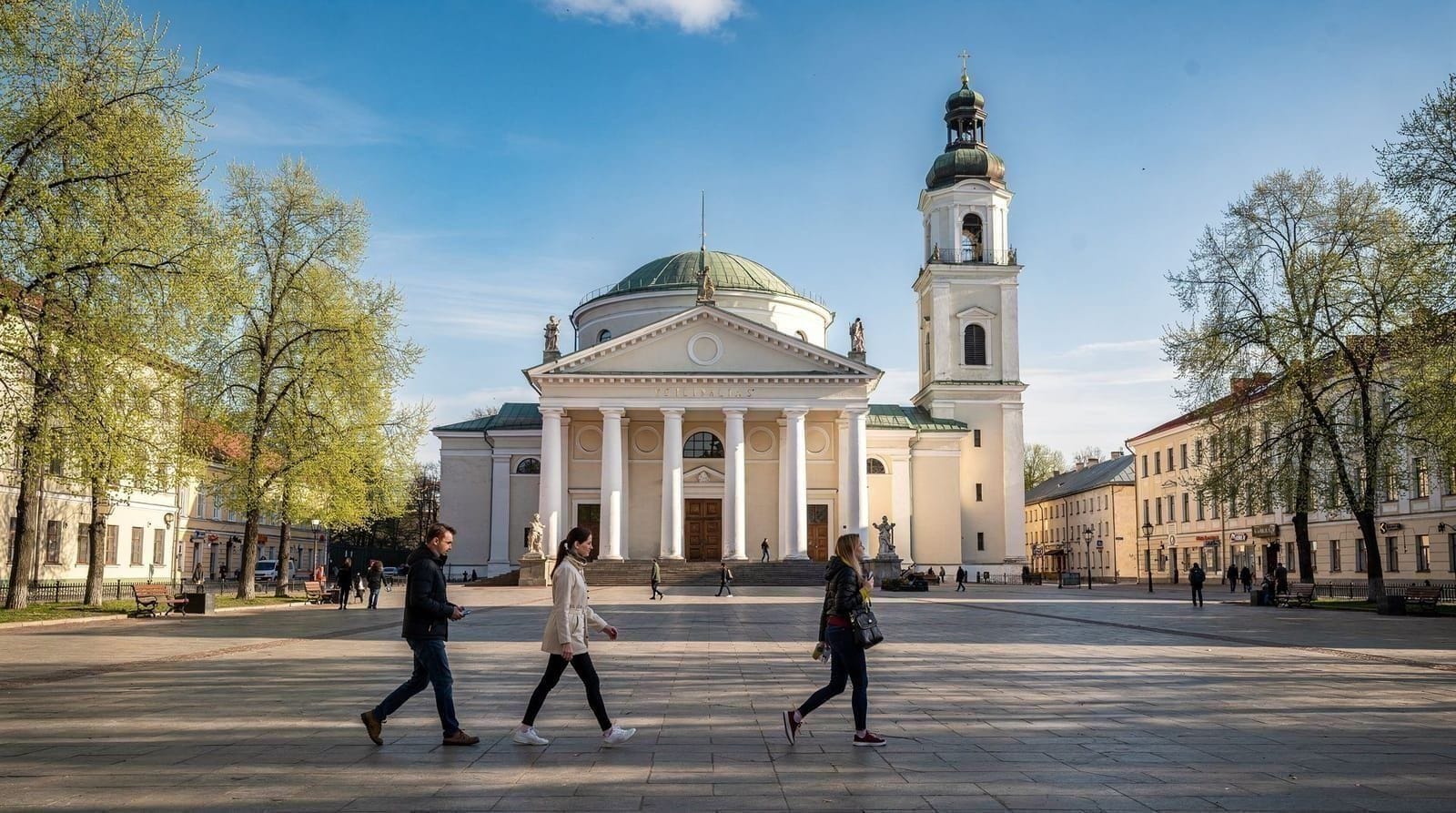
The Church of St. Johns, which forms the north side of the Great Courtyard, was begun in the 15th century in Gothic style and extended and rebuilt through the Baroque period. The result is one of the most complete Baroque church interiors in Lithuania.
Entry is free and the church is open to visitors Monday–Saturday 10 am–6 pm (shorter hours outside tourist season). The 18 side chapels, high altar, and frescoed ceiling repay careful attention. The twin-towered facade on the courtyard side dates from 1737 and is often used as the background for university ceremonies and graduation photography.
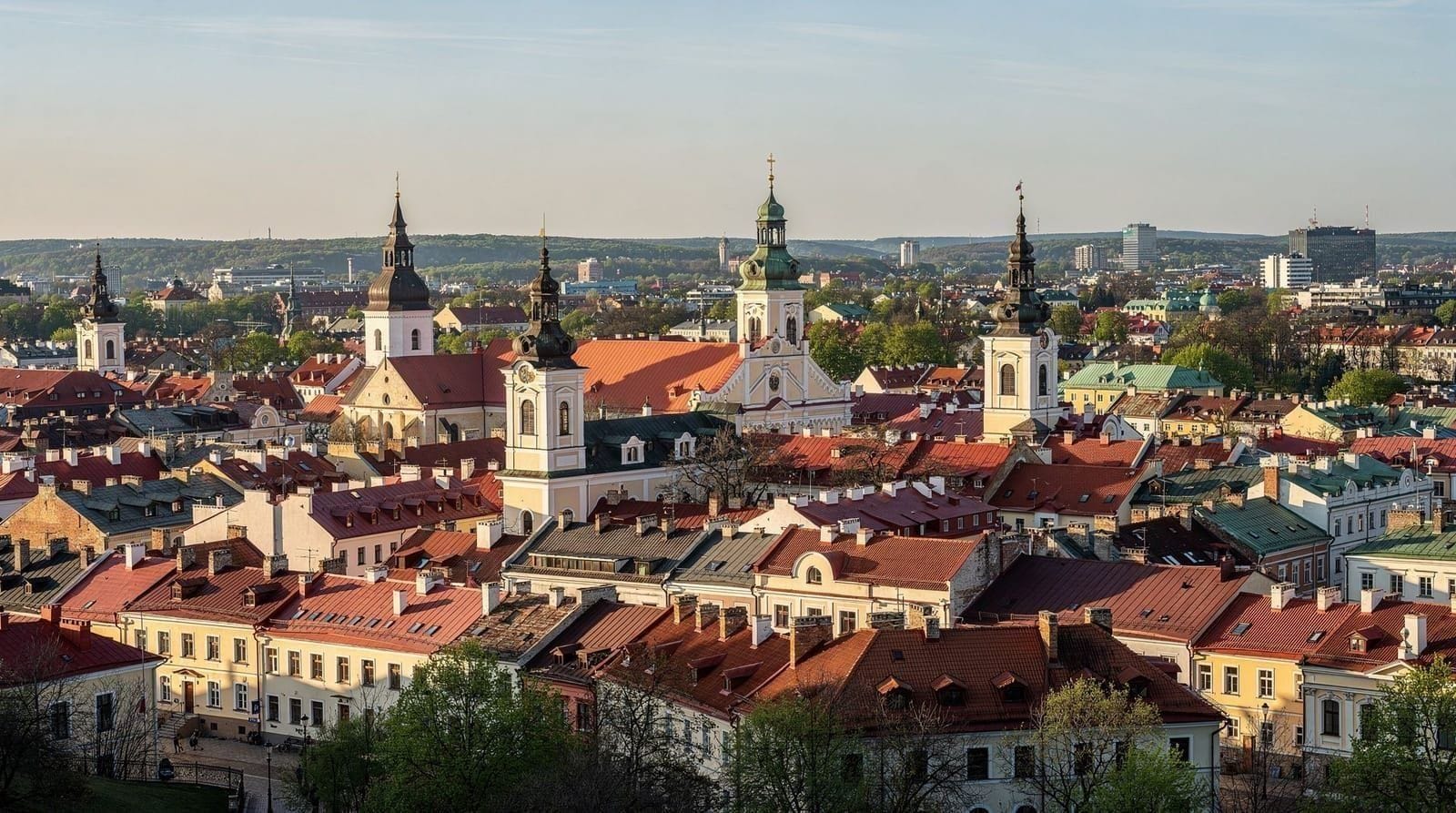
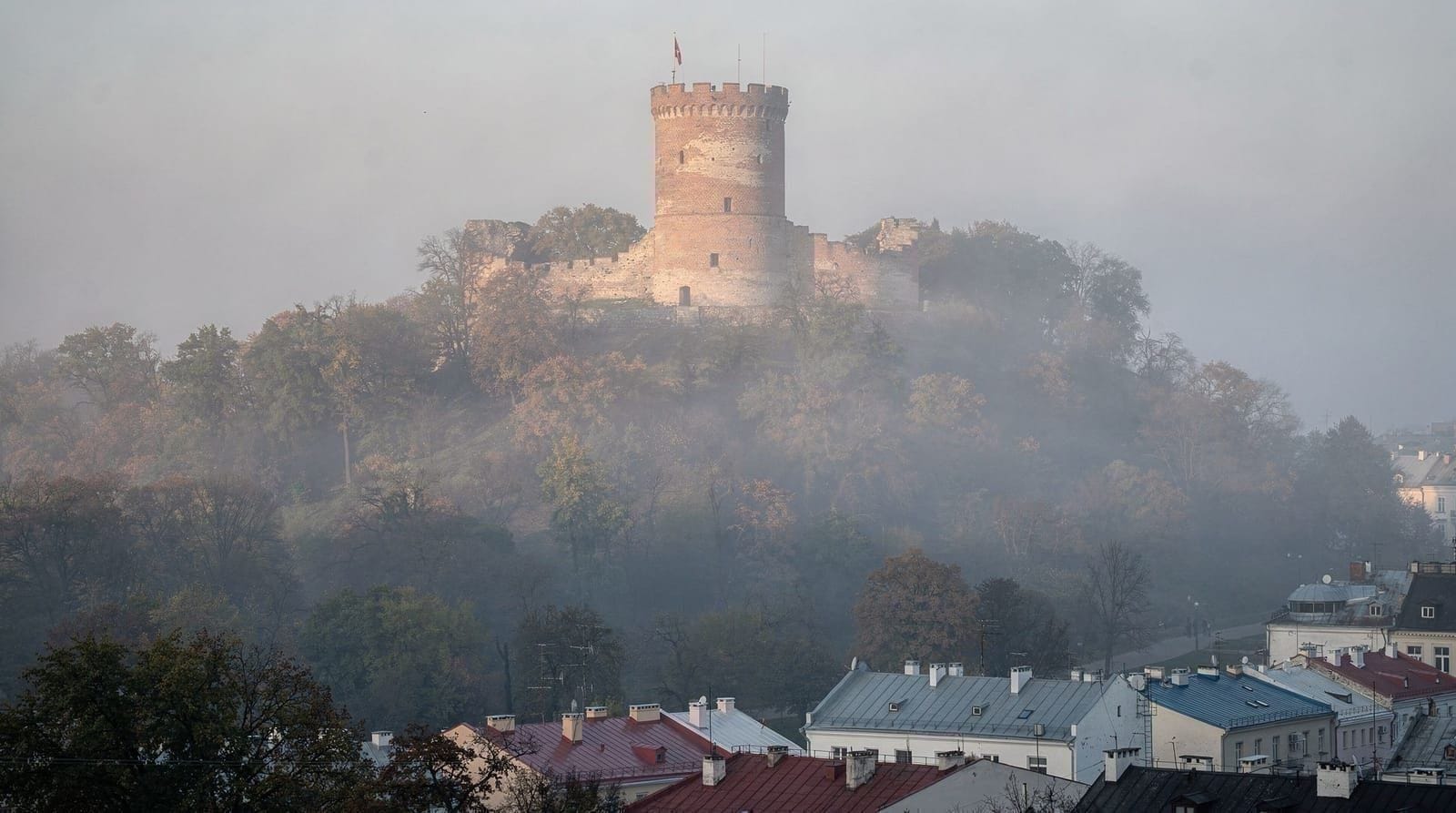
The bell tower (varpinė) of the church can be climbed (€4, open daily 10 am–5 pm May–October). The view from the top takes in the Great Courtyard from above, the rooftops of the Old Town to the south, and Gediminas Hill rising to the north.
Practical visiting information
Entry: The courtyards are accessed through gates on Šv. Jono gatvė (main entrance), Universiteto gatvė (southern gate), and Pilies gatvė (northern gate near the bookshop). A suggested donation of €1.50 is collected at the main gate. The Church of St. Johns is free and separately entered from the Great Courtyard.
Opening hours: Courtyards daily 9 am–6 pm (closes at 5 pm October–April). Church of St. Johns Monday–Saturday 10 am–6 pm; Sunday 10 am–3 pm (closed during services). Bell tower May–October 10 am–5 pm.
Duration: A relaxed walk through all five main courtyards plus the church takes 45–75 minutes. Add the bell tower for another 20 minutes.
Accessibility: Ground-floor courtyards are accessible by wheelchair. The bell tower, observatory, and some upper floors are not accessible.
Quiet hours: Being an active university, some corridors and stairways close during exam periods (January and June). The main courtyards and church remain open.
A guided Old Town walk covering the university adds historical depth that the courtyards’ limited signage does not provide — particularly the Jesuit founding period and the university’s role in the 19th-century national revival.
The bookshop and surroundings
The university’s bookshop (Knygų kiemas, entrance on Šv. Jono gatvė 12) stocks a good range of books on Lithuanian history, art, and literature — including some titles available in English that are hard to find elsewhere. Academic maps of the courtyards are also sold here.
On Pilies gatvė adjacent to the northern university gate, several street stalls sell second-hand books in Lithuanian, Polish, and Russian. The quality varies but browsing is free.
How the university fits your Old Town day
The university courtyards sit at the heart of the Vilnius Old Town, a short walk from Cathedral Square, which makes it easy to fold into a wider Old Town walk rather than treating it as a separate outing. Most first-time visitors pair it with the cathedral and Pilies Street in the same morning, then continue toward Gediminas Tower or across to Užupis in the afternoon. If Baroque architecture is a specific interest, the university’s Church of St. Johns is one of the best examples in the city — our Vilnius Baroque architecture guide places it in context alongside the other major Baroque churches nearby.
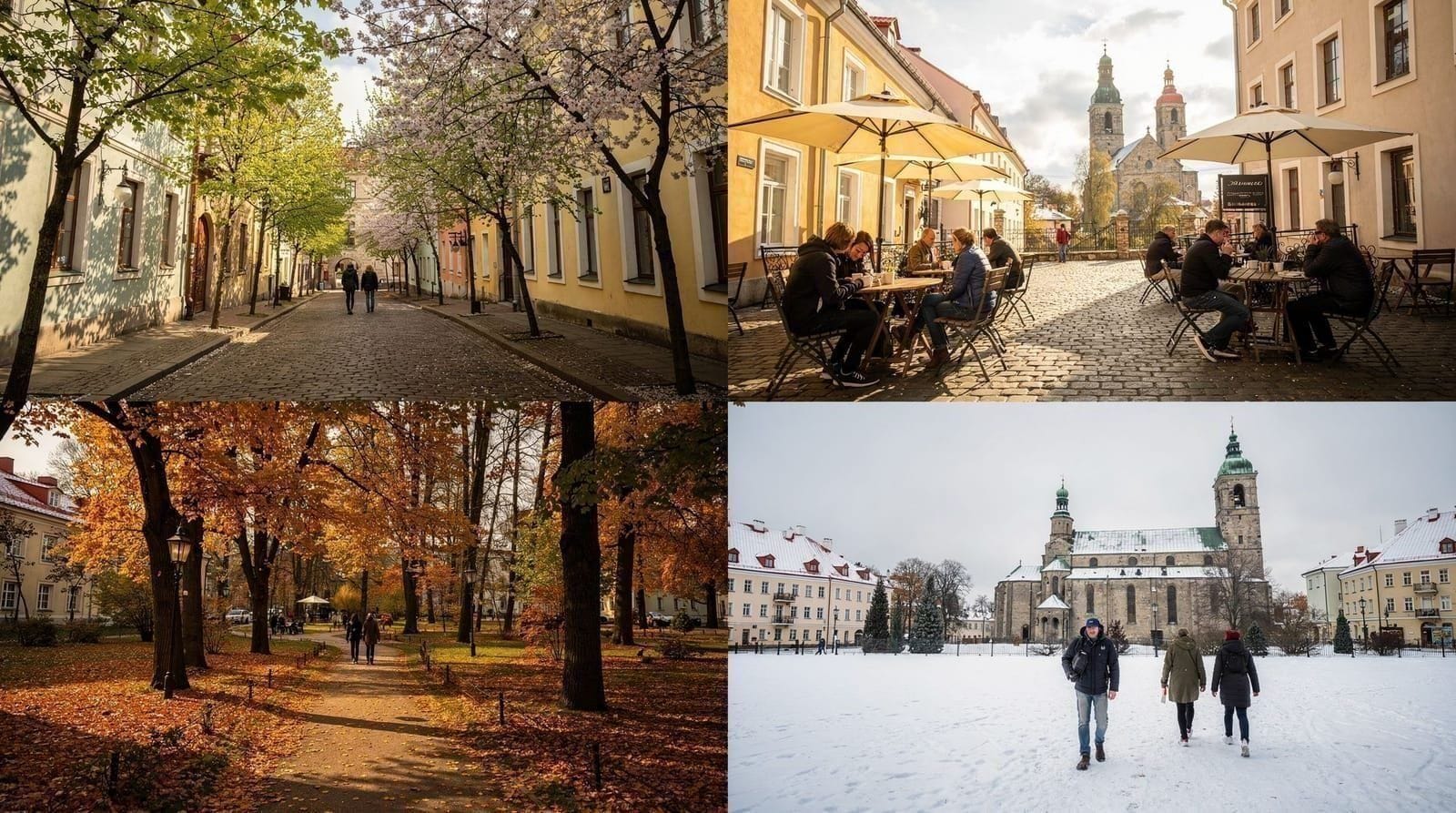
For visitors curious about the university’s role in Vilnius folklore and civic identity — student traditions, ghost stories associated with the older buildings, and the symbolism behind some of the courtyard carvings — the Vilnius legends and myths guide covers several stories tied specifically to the university complex. Because the courtyards are compact and centrally located, they also work well as a rainy-day option; unlike the outdoor viewpoints around the city, most of the university visit is under cover or in enclosed courtyards, making it a reliable back-up plan regardless of season — see best time to visit Vilnius for how weather affects the wider trip.
Frequently asked questions about Vilnius University
Can I sit in on a lecture at Vilnius University?
Not without prior arrangement. The university is open to the public in its historic courtyards and the Church of St. Johns, but academic areas — lecture theatres, faculty buildings, and the library stacks — are for students and faculty only.
Is Vilnius University photographable?
Yes, photography in the courtyards and church is freely permitted. Some faculty offices facing the courtyards have privacy screens but courtyard and church photography are unrestricted.
What language is Vilnius University taught in?
Lithuanian is the primary language of instruction. An increasing number of graduate programmes are offered in English, particularly in law, business, and life sciences. The historic working language was Latin (16th–18th century), then Polish (19th–early 20th century).
Is there a café inside the university?
Yes — a small student canteen on the ground floor of the main building (enter from Universiteto gatvė) serves hot lunches on weekdays 11 am–2 pm (€4–7 for a full meal). It is open to visitors and is honest, cheap, and unremarkable, which is probably what you want after an expensive Old Town lunch.
Top experiences
Bookable activities with verified prices and instant confirmation on GetYourGuide.